Google and five PC makers have launched the first Googlebook AI laptops ranging from $899 to $1,299 with preorders starting today and retail availability on October 4. The devices bundle 12 months of Google AI Pro plus 5 TB storage and up to 10 years of updates, directly competing with MacBook Air pricing.
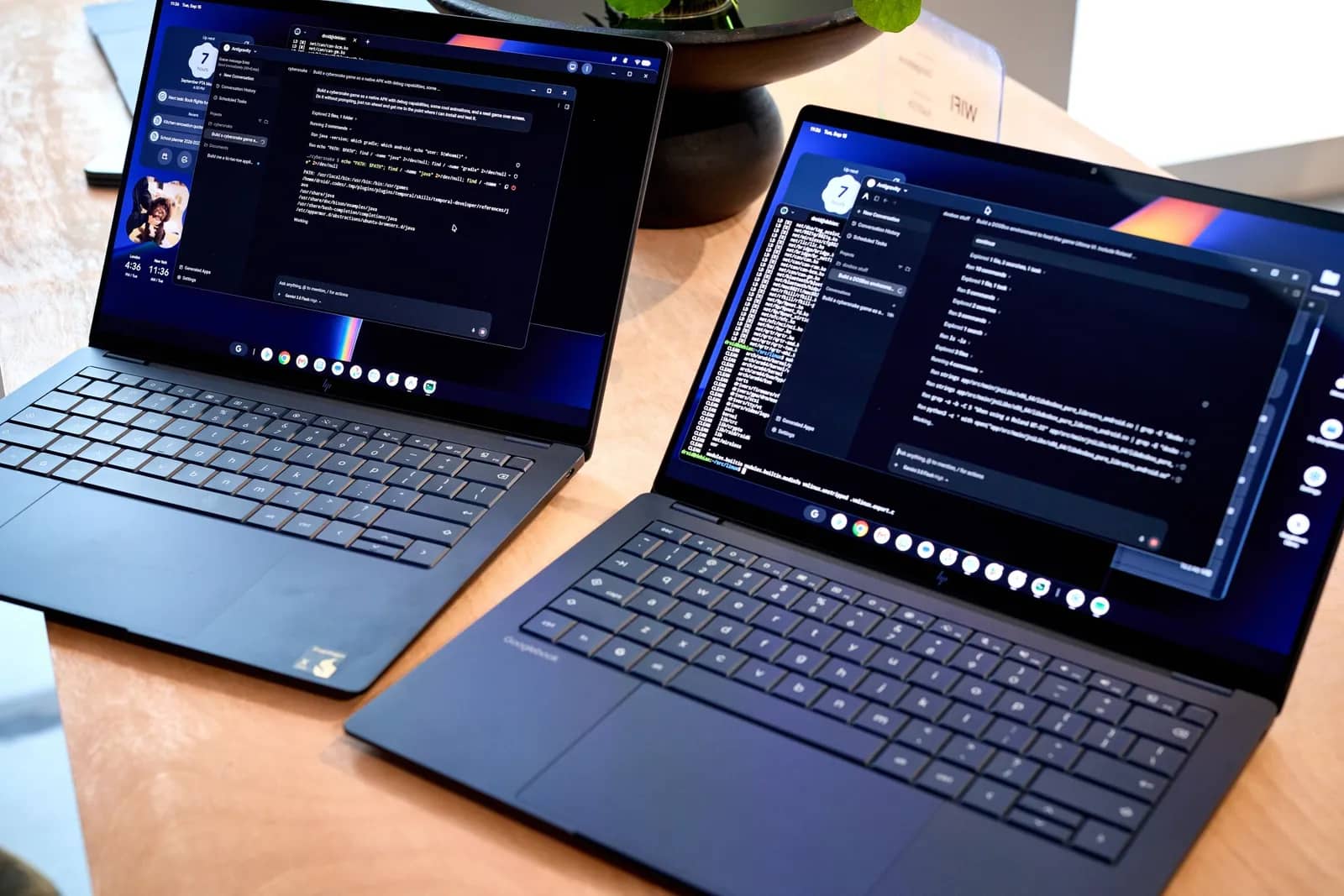
Wrong (tweet leftover after Sep 21 body fix): Acer 2.5 lb / Dell 2.2 lb and omitted Dell LCD. Right: Acer 2.7 lb, Dell XPS 2.5 lb with LCD callout — matching corrected body (THE-121 incomplete sweep).
Wrong: Acer Googlebook 14 weight listed as 2.5 lb; Dell XPS Googlebook as 2.2 lb; Lenovo Googlebook 15 as 2.84 lb; and a blanket “OLED displays” claim for all five models. Right: Acer 2.7 lb, Dell 2.5 lb, Lenovo 2.68 lb per Ars Technica’s launch specs table (Sep 21, 2026); Dell’s XPS Googlebook uses a 2.5K LCD touchscreen, not OLED. HP rounded to 2.7 lb.
Google is pledging up to 10 years of software updates.
The lineup is aimed at the same premium segment occupied by the MacBook Air and many Windows-based rivals.
Tap a lens to see what this story means for you.
Liked this? The Brief brings you the whole day in tech, verified, every morning.
Two minutes, free forever. What's in The Brief →
See what’s happening right now
The Feed runs all day — short, verified briefs the moment they break.
Open the FeedFollow @thecircuitry_
Every story we publish, as it happens. No noise between.
Reader-supported
The Circuitry is a passion project I've always wanted to build, and I love the work behind it.
Running it costs real money. APIs, hosting, time. To keep improving the site and growing this into something useful for everyone, those costs have to be covered.
Any contribution is appreciated. If not, no pressure. Thanks for reading.
OpenAI's chief scientist has proposed shared limits on model perplexity and published internal scores from GPT-3.5 onward. Those scores put GPT-3.5 near 0.99 and GPT-4 near 0.91, and the proposal asks labs not to cross a shared bar until monitoring improves.
OpenAI has cut the average success rate of attacks that extract protected reasoning from an earlier request to 0.2% on GPT-6.2 Astra, from 54.0% on GPT-6 Astra. Current-request attacks are at 0.9%, and selected safeguard improvements are being applied back to GPT-6 Astra.
OpenAI has introduced MedChemBench, a 99-problem test of how models read molecules, explain lab results, and choose the next compound. At the xhigh setting, GPT-6.2 Astra scored 84.5%, while compound choice and property forecasts remain much weaker than structure work.
Google has set January 25, 2027 to retire the Nest app and August 2, 2027 to retire Google Assistant on speakers and smart displays. Nest devices and camera history move to the Google Home app, but clips saved by hand do not.
Google has built a Gemini tool that flags a new wildfire radio dispatch in under 30 seconds and cuts word errors on bad VHF audio from 38% to 22.34%. Watch Duty used the tool in July to send its first overnight Critical Alert during Washington's Railroad Fire.