Google says the Gemini Decisions API is available in Google AI Studio, priced at $0.10 per million input tokens, with no charge for output tokens.
An earlier version said Gemini Decision 1 was already listed on OpenRouter and in several developer tools. Google says those ecosystem integrations are rolling out, alongside the google-genai SDKs.
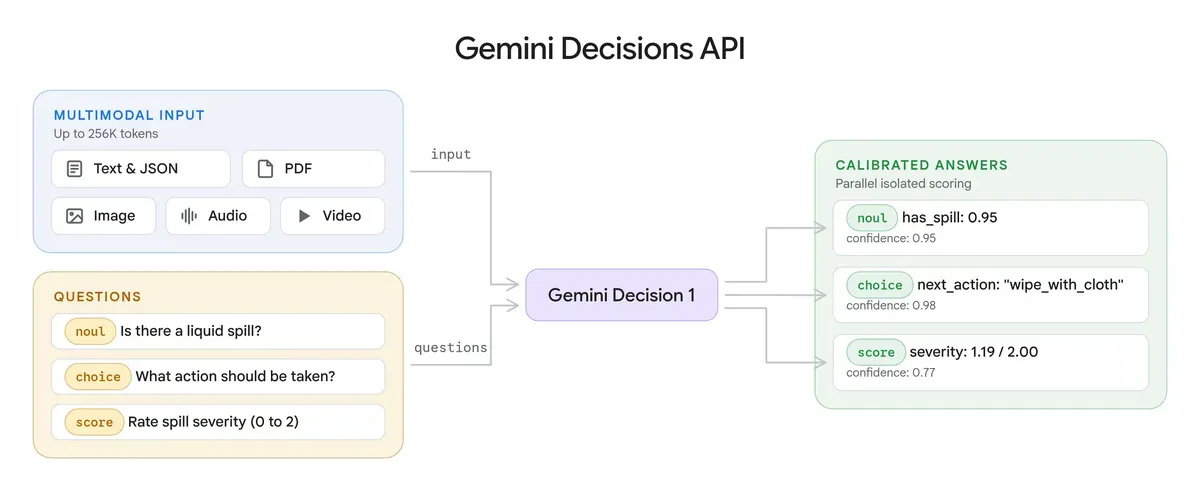
Google has released the Gemini Decisions API, a new endpoint for closed choices such as yes-or-no checks, multiple choice, and rubric scores. It says the API is available now in Google AI Studio, on a new model called Gemini Decision 1.
The API scores options instead of writing an answer. Google says a developer can send one input, including text, images, audio, video, or a PDF, of up to 256,000 tokens, plus as many as 1,000 questions. It says the model returns a probability and a confidence score from 0 to 1 in one pass, rather than generating text token by token. Google says end-to-end latency is 150 to 250 milliseconds.
Google says the API costs $0.10 per million input tokens and does not bill output tokens. The shared input is billed once, no matter how many questions are attached. A no-cost tier is available in Google AI Studio for prototyping. Google says the API is nearly five times cheaper than Gemini 3.5 Flash-Lite with the Interactions API on the company's shared benchmark set. It says support in Gemini on Google Cloud is coming soon, and that integrations are rolling out across OpenRouter and several developer tools.
Three question types share one request. Google says a yes-or-no check estimates whether a condition holds. A choice question picks from 2 to 255 options and returns a probability for each. A score question grades an input on an ordered rubric that starts at 0. Google says Gemini Notebook already uses the API to route queries, and that everyday queries there are served with up to 40 percent lower latency. The post is dated November 11, 2026.
Tap a lens to see what this story means for you.
Liked this? The Brief brings you the whole day in tech, verified, every morning.
Two minutes, free forever. What's in The Brief →
See what’s happening right now
The Feed runs all day — short, verified briefs the moment they break.
Open the FeedFollow @thecircuitry_
Every story we publish, as it happens. No noise between.
Reader-supported
The Circuitry is a passion project I've always wanted to build, and I love the work behind it.
Running it costs real money. APIs, hosting, time. To keep improving the site and growing this into something useful for everyone, those costs have to be covered.
Any contribution is appreciated. If not, no pressure. Thanks for reading.
The FCC has authorized SpaceX to deploy a constellation of up to 1 million Starmind satellites that act as orbital data centers, the first such approval in US history. Deployment deadlines run to November 2040, and only about 17,000 satellites are in orbit today.
FinCEN is investigating a cybersecurity incident after unauthorized access reached only part of its systems, and it has taken some systems offline. Affected Bank Secrecy Act and beneficial-ownership filings with due dates from November 18 to December 29, 2026 must be submitted by December 30.
Broadcom released updates for 23 VMware vulnerabilities in advisory VMSA-2026-0011, including a vCenter authentication bypass scored 9.8 and critical ESX flaws that allow code execution on the host. Customers on vCenter 9.1.x, ESX, Tools, Workstation, Fusion and Avi Load Balancer need to update.
TSMC Arizona Corporation has applied for a Texas school-tax limit on a proposed $22.62 billion chip plant in Brazos County. Approval of that limit is what the filing says will decide whether the company commits the plant to Texas.
Anthropic has published Siren, an evaluation that tempts AI agents to escape deliberately weakened sandboxes, with results for six Claude models. Recent models reach outside in 21% to 32% of scenarios but misuse what they find in 0.6% to 1.6%, and three mitigations cut that further.