Microsoft says Copilot on Copilot+ PCs will be able to use files and recent activity on your PC, take actions across Windows, and tap local AI models, with your permission. The features are expected to start rolling out in the coming months.
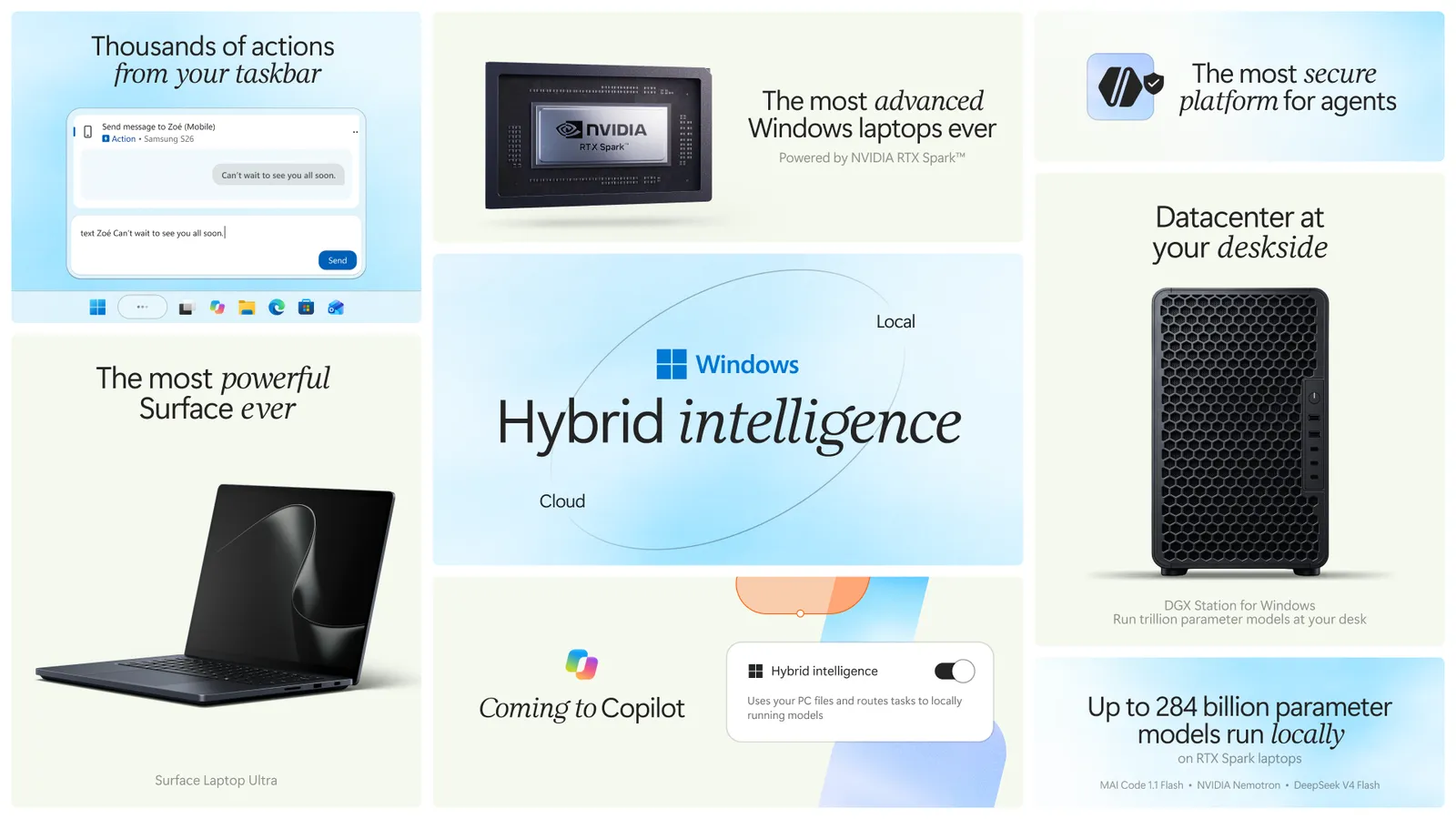
With your permission, Copilot will be able to use local context from your PC, take action on your behalf, and tap into local models.
Copilot features powered by hybrid intelligence are expected to begin rolling out on Copilot+ PCs in the coming months.
Tap a lens to see what this story means for you.
Liked this? The Brief brings you the whole day in tech, verified, every morning.
Two minutes, free forever. What's in The Brief →
See what’s happening right now
The Feed runs all day — short, verified briefs the moment they break.
Open the FeedFollow @thecircuitry_
Every story we publish, as it happens. No noise between.
Reader-supported
The Circuitry is a passion project I've always wanted to build, and I love the work behind it.
Running it costs real money. APIs, hosting, time. To keep improving the site and growing this into something useful for everyone, those costs have to be covered.
Any contribution is appreciated. If not, no pressure. Thanks for reading.
At its Windows and Surface event, Microsoft opened preorders for the $2,599 Surface Laptop Ultra and the $5,999 Surface RTX Spark Dev Box, and said Copilot will be able to use files and act across Windows in the coming months.
Microsoft demonstrated hybrid intelligence on Windows that runs AI models from 70 billion to 284 billion parameters locally. The approach keeps data on-device, supports offline use, and switches to cloud models for heavier tasks.
Microsoft has introduced a local edition of MAI-Code-1.1-Flash that runs on Windows PCs without server access. The model requires substantial memory and is coming to GitHub Copilot in experimental preview by the end of October, starting with Nvidia RTX Spark PCs.
The first laptops built on Nvidia's RTX Spark chip, from Microsoft, Asus, Dell, HP, Lenovo and MSI, start at $2,599 and climb to $6,999.99 for a maxed-out Asus ProArt P16 with 128GB of unified memory, The Verge reports. The first models ship as early as October 16.
Anthropic released Claude Haiku 5.5, its cheapest and fastest small model, at $0.10 per million input tokens and $0.50 per million output tokens for prompts up to 100,000 tokens. Anthropic says it costs around 75% less to run than Haiku 4.5 on average and scores far higher on its benchmarks.