SpaceX is targeting no earlier than May 19 for Flight 12, the debut of Starship V3 and Launch Pad 2 following a successful integrated tanking test. The suborbital mission will test redesigned vehicles, Raptor 3 engines, hot staging, an enhanced heat shield and new Starlink simulators as the company works toward supporting the Artemis 3 mission in 2027.
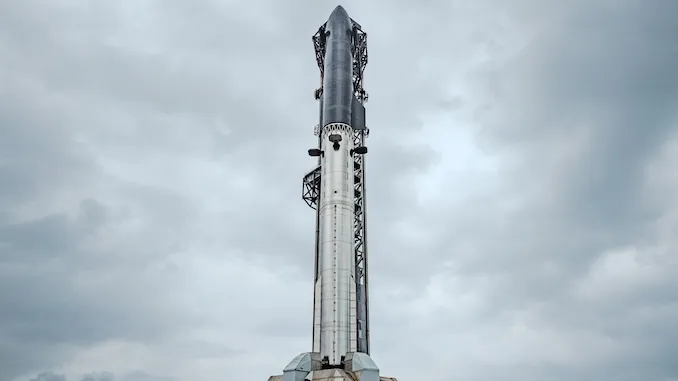
SpaceX has set its sights on a no-earlier-than Tuesday, May 19, liftoff for the debut of the third major version of its Starship-Super Heavy stack. The update followed completion of an integrated tanking test the previous day. In that rehearsal that mirrored a full countdown sequence, the company loaded more than 5,000 metric tonnes (11+ million pounds) of propellant aboard the fully integrated Starship and Super Heavy V3 stack for the first time.
Flight 12 will represent the initial outing of the collective design known as Starship V3 while also marking the inaugural use of Pad 2. This upgraded facility incorporates launch and catch infrastructure. The V3 vehicles will fly with an updated Raptor engine design called Raptor 3.
“The flight test’s primary goal will be to demonstrate each of these new pieces in the flight environment for the first time, with each element of the Starship architecture featuring significant redesigns to enable full and rapid reuse that incorporate learnings from years of development and test,” SpaceX said on its website. The test will evaluate a host of changes made to both the launch vehicle and the launch infrastructure as SpaceX prepares to support the Artemis 3 mission in 2027.
https://x.com/SpaceX/status/2053929135936864393
Like earlier Starship trials, the trajectory stays suborbital. Given the array of novel hardware involved, the company will skip attempts to catch either the Ship 39 upper stage or the Booster 19 first stage. Instead, Booster 19 is slated for a controlled splashdown in the Gulf of Mexico (referred to as Gulf of America by the U.S. Government) roughly seven minutes after launch. Ship 39 will target a water landing of its own in the Indian Ocean a little more than an hour after liftoff.
The booster now features an integrated hot stage that leaves the forward dome of its fuel tank exposed while the upper stage lights its engines. A non-structural steel layer, working together with internal tank pressure, protects the liquid methane tank from the exhaust plume.
As on Flights 10 and 11 the year before, the upper stage will release simulator Starlink satellites—22 of them this time, roughly double the prior count—with two carrying fresh capabilities. “The last two satellites deployed will scan Starship’s heat shield and transmit imagery down to operators to test methods of analyzing Starship’s heat shield readiness for return to launch site on future missions,” SpaceX said. “Several tiles on Starship have been painted white to simulate missing tiles and serve as imaging targets in the test.”
Flight 12 will also fly a much more intact heat shield than before. Where earlier missions deliberately flew with several tiles omitted, only a single tile is planned to be absent at liftoff. “For Starship entry, a single heat shield tile has been intentionally removed to measure the aerodynamic load differences on adjacent tiles when there is a tile missing,” SpaceX said.
The Raptor 3 engines bring further performance gains. “Raptor 3 engines deliver increased thrust, with sea-level variants now producing 250 tf (551,000 lbf) up from 230 tf (507,000 lbf), while vacuum engines produce 275 tf (606,000 lbf) up from 258 tf (568,000 lbf),” SpaceX said.
Tap a lens to see what this story means for you.
Liked this? The Brief brings you the whole day in tech, verified, every morning.
Two minutes, free forever. What's in The Brief →
See what’s happening right now
The Feed runs all day — short, verified briefs the moment they break.
Open the FeedFollow @thecircuitry_
Every story we publish, as it happens. No noise between.
Reader-supported
The Circuitry is a passion project I've always wanted to build, and I love the work behind it.
Running it costs real money. APIs, hosting, time. To keep improving the site and growing this into something useful for everyone, those costs have to be covered.
Any contribution is appreciated. If not, no pressure. Thanks for reading.
SpaceX Starship reached orbit for the first time on its 14th test flight from Texas on September 28 despite an early engine shutdown. The vehicle is expected to complete six orbits over 10 hours and deploy 26 Starlink V3 satellites before Pacific splashdown.
SpaceX has delayed the first orbital Starship flight from September 22 to September 28 pending regulatory approval. The mission will attempt to place 26 V3 Starlink satellites into a 275 km orbit and marks a key milestone after the program's initial test flight in 2023.
SpaceX plans to attempt catching its Starship spacecraft with mechanical tower arms on the next test flight following a successful ocean landing on Flight 13. The milestone would advance the vehicle's reusability after demonstrating satellite deployment and an in-flight engine restart.
SpaceX completed a static fire of Booster 20 on July 10, clearing the path for Starship's 13th test flight as early as July 15. The test continues development of the Version 3 vehicle toward full operational capability including stage recovery and reuse.
SpaceX has agreed to acquire Grain Management's nationwide 800 MHz spectrum portfolio, which it says will pave the way for Starlink Mobile to become a major US mobile carrier. The deal needs FCC approval, and financial terms were not disclosed.