The Circuitry
THE CIRCUITRYYour one-stop source for all tech news
HOMETODAYNEWSFEEDEVENTS
BOOKMARKS
RSS
© 2026 The Circuitry
About UsSourcesContactCorrectionsPrivacy
  • Today
  • Feed
  • Events
  • Saved
Scroll for more
Verification
VERIFIEDConfidence: HIGH
Source identified
Claims cross-referenced
No discrepancies found
Fact-check summary

Reported directly by AWS Blog — the official primary source for this announcement.

Sourcing
1source

via AWS Blog

AWS Blog · track record
5Stories
100%Verified
130d
All sources →
Markets
AMZN···

Live quote · not investment advice

Home/Tech/Amazon S3 annotations attach up to 1 GB of mutable context per object
VERIFIEDBy Xavier Rivera· ·2 min read

Amazon S3 annotations attach up to 1 GB of mutable context per object

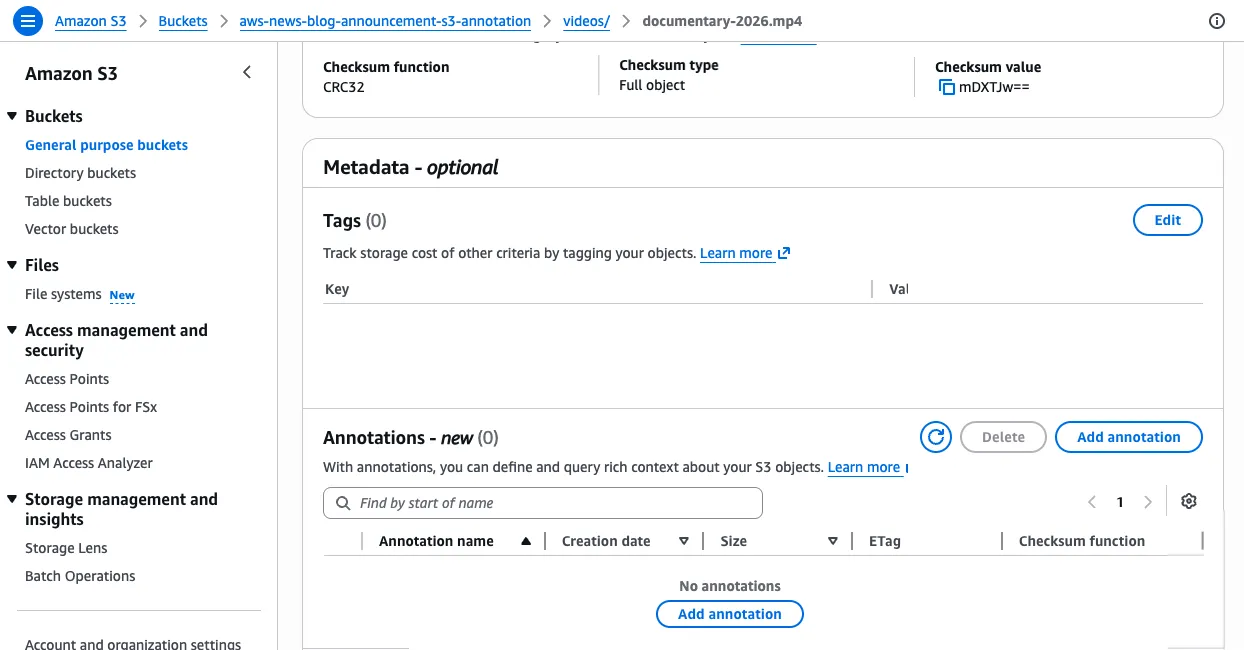
AWS launched S3 annotations that attach up to 1 GB of mutable, queryable context per object in formats such as JSON and XML. The capability eliminates separate metadata systems for AI agents by automatically propagating context with objects and enabling direct queries via Athena without retrieval charges for any storage class.
Source:AWS Blog
Post
Amazon S3 annotations attach up to 1 GB of mutable context per object
TL;DRAI · 60 sec read

Amazon Web Services adds annotations to S3, letting users attach up to 1 GB of mutable metadata per object in JSON, XML or similar formats. Up to 1,000 entries travel with objects during copies and replication, remain queryable via Athena, and support AI agents without separate databases or prior metadata limits on size and mutability.

Amazon Web Services has introduced annotations, a new metadata feature for its S3 object storage that lets customers attach rich business context directly to stored items.

S3 annotations support up to 1,000 named entries per object. Individual entries can each measure 1 MB, for a combined maximum of 1 GB. Supported formats include JSON, XML, YAML and plain text. Any annotation can be edited or removed without altering the original object.
The capability targets AI agents and autonomous workflows that locate, interpret and operate on data independently.
The capability targets AI agents and autonomous workflows that locate, interpret and operate on data independently. Annotations remain synchronized as information changes, extend across petabyte-scale collections and stay directly queryable without external stores.

Annotations travel with objects across operations. Context automatically follows during copy, replication and cross-region transfers. The service deletes annotations upon object removal.
From The CircuitryThe Feed — live briefs across tech, all day.See what’s happening →
Enabling S3 Metadata routes annotations into managed tables. These can be queried through Amazon Athena or comparable analytics tools. The feature functions with every storage tier, reportedly including Amazon S3 Glacier classes, without restoration or retrieval fees.
Previously, comparable detail lived in separate databases or companion files, generating synchronization costs that sometimes surpassed storage itself.
Use cases span media, finance, and life sciences. Media teams apply separate annotations for transcripts, moderation outcomes, subtitles and licensing details on video files instead of aligning multiple asset systems. Financial groups link AI-produced investment summaries and sentiment scores to documents so agents can surface relevant sets via natural-language searches. Life-sciences users tag trial records with compliance status, cohort information and approval histories, accelerating audits on archived data.

Annotations overcome limits of existing S3 metadata options. System-defined fields remain immutable and cover only intrinsic attributes such as size or class. User-defined metadata cannot exceed 2 KB and must be supplied at creation. Tags are restricted to 10 per object with tight character caps and primarily support access rules or lifecycle policies.
By contrast, annotations deliver mutable, large-scale context reaching 1 GB per object. Previously, comparable detail lived in separate databases or companion files, generating synchronization costs that sometimes surpassed storage itself. The S3 Tables MCP server supplies a uniform interface allowing AI models to query annotations through natural language.
Why this mattersAI · ~100 words

Tap a lens to see what this story means for you.

Reader-supported
DonateBuy me a coffee →Follow@thecircuitry_ →Follow@thecircuitry.to →

Reader-supported · The Brief

Liked this? The Brief brings you the whole day in tech, verified, every morning. Two minutes, free forever.

HELP US IMPROVE
From The Circuitry

See what’s happening right now

The Feed runs all day — short, verified briefs the moment they break.

Open the Feed →
From The Circuitry

Follow @thecircuitry_

Every story we publish, as it happens. No noise between.

Follow on X ↗On Bluesky ↗

Reader-supported

The Circuitry is a passion project I've always wanted to build, and I love the work behind it.

Running it costs real money. APIs, hosting, time. To keep improving the site and growing this into something useful for everyone, those costs have to be covered.

Any contribution is appreciated. If not, no pressure. Thanks for reading.

Buy me a coffee
AWSS3MetadataAI Agents
More fromAWS Blog
  • AWS Builder Center turns 1 with sandbox environments

    Tech · 25d
  • AWS Lambda Introduces MicroVMs for Isolated, Stateful Sandboxes

    Tech · 1mo
  • AWS Launches Graviton5-Powered EC2 M9g Instances

    Tech · 1mo
More inTech
  • Tesla and SpaceX confirm Terafab chip fab in Texas

    Tech · 1d
  • OpenAI Urges Federal Judge to Throw Out Apple's Trade Secrets Complaint

    Tech · 2d
  • Meta introduces Muse Code, its terminal-based coding agent

    Tech · 2d
SupportThe Work

The Circuitry is reader-supported. If you find the daily brief useful, you can buy me a coffee to keep it going.

Buy a coffee →
SubscribeCircuitry Brief

Liked this? The Brief brings you the whole day in tech, verified, every morning. Free forever.

MORE IN TECH

Tesla and SpaceX confirm Terafab chip fab in Texas

Tesla and SpaceX have confirmed Grimes County, Texas as the site for their Terafab semiconductor megafactory, with the first phase costing roughly $16.8 billion. The project targets the largest chip manufacturing facility on the planet to supply over 1 terawatt of compute per year that exceeds current and future global production capacity.

OpenAI Urges Federal Judge to Throw Out Apple's Trade Secrets Complaint

OpenAI has filed a motion asking a federal judge to dismiss Apple's trade secrets lawsuit, describing the claims as meritless. The dispute, which follows a July suit and this week's injunction request from Apple, highlights tensions after their prior partnership on Siri and OpenAI's hardware push.

Meta introduces Muse Code, its terminal-based coding agent

Meta has released an early beta of Muse Code, a terminal-based coding agent driven by the updated Muse Spark 1.2 model and positioned against Anthropic's Claude Code and OpenAI's Codex. Substantially lower rates, including a contributor plan at $0.10 for every million tokens received, may encourage migration away from higher-priced options such as Anthropic's Sonnet 5.