The Circuitry
THE CIRCUITRYYour one-stop source for all tech news
HOMETODAYNEWSFEEDEVENTS
BOOKMARKS
RSS
© 2026 The Circuitry
About UsSourcesContactCorrectionsPrivacy
  • Today
  • Feed
  • Events
  • Saved
Scroll for more
Verification
VERIFIEDConfidence: HIGH
Source identified
Claims cross-referenced
No discrepancies found
Fact-check summary

Multiple outlets (China Daily, NASA Earth Observatory, Yahoo, gov.cn) confirm the 400 km Kubuqi “Great Photovoltaic Wall” solar project targeting 100 GW by 2030.

Sourcing
1source

via Frandroid

Frandroid · track record
44Stories
100%Verified
530d
All sources →
Home/Energy/China Plans 400 km Solar Wall to Fight Desertification
VERIFIEDBy Xavier Rivera· ·2 min read

China Plans 400 km Solar Wall to Fight Desertification

China is building a 400 km solar corridor along the Kubuqi Desert that will reach 100 GW by 2030 while helping halt desert expansion. The dual-purpose project already has sections operating and could generate nearly 40 TWh of electricity annually.
Source:Frandroid
Post
China Plans 400 km Solar Wall to Fight Desertification
TL;DRAI · 60 sec read

China has started a 400-kilometer solar corridor project along the Kubuqi Desert. Multiple photovoltaic parks will reach 100 GW total capacity by 2030 and generate 40 terawatt-hours yearly. The panels help fight desertification by shielding soil from intense sunlight and supporting vegetation regrowth in affected areas.

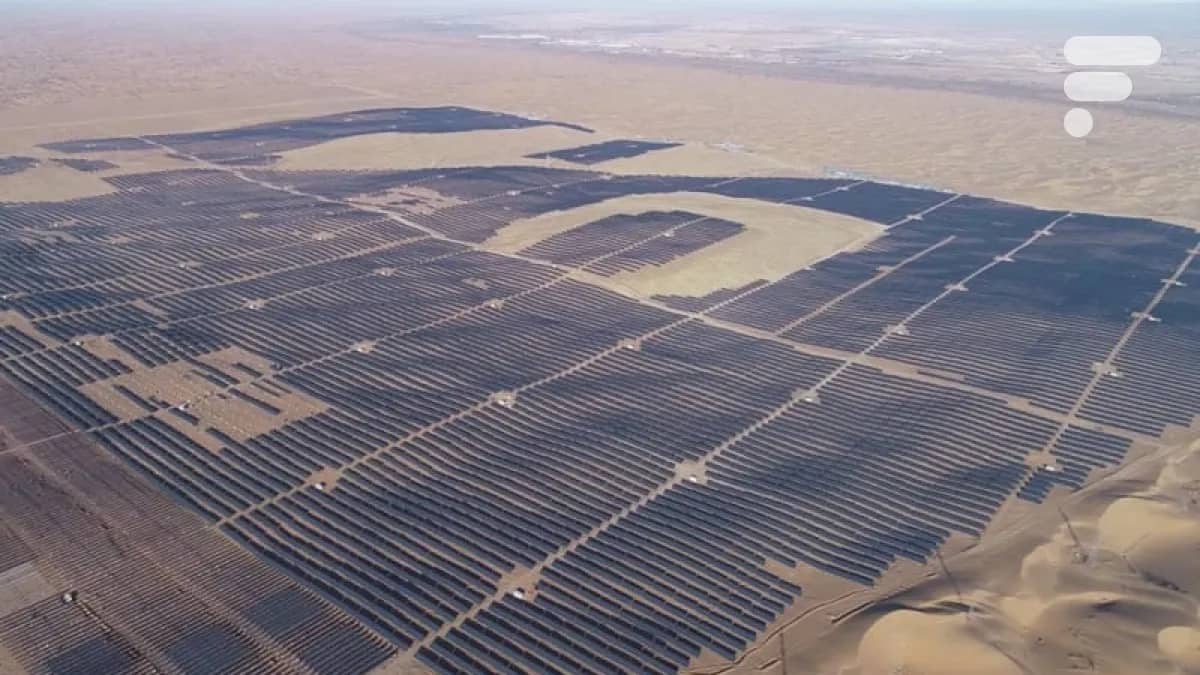
China has launched construction of a 400-kilometer solar corridor along the edge of the Kubuqi Desert in Inner Mongolia. The project, already dubbed the “Great Photovoltaic Wall” by local media, combines large-scale renewable energy generation with efforts to halt desert expansion and restore ecosystems.

The solar corridor reaches 400 km in length. The installation consists of a series of photovoltaic parks developed by different energy-sector players rather than one single plant. It lines the northern edge of the Kubuqi Desert with panels that can reach up to 5 km in width in places.
The Junma plant, one completed section, features panels arranged in the shape of a galloping horse and holds a Guinness World Record as the world’s largest photovoltaic image.

The full corridor targets 100 GW of installed capacity by 2030. Once complete it is expected to generate nearly 40 terawatt-hours of electricity per year, an output local media compare to roughly 9 percent of France’s annual electricity consumption in 2025.

Portions of the project are already operational. The Junma plant, one completed section, features panels arranged in the shape of a galloping horse and holds a Guinness World Record as the world’s largest photovoltaic image. Chinese media reported more than 10 GW of capacity installed across 47,000 hectares in 2025, with nearly 29 GW under construction at that time.
From The CircuitryThe Feed — live briefs across tech, all day.See what’s happening →

NASA imagery from the end of 2024 showed only about 5.4 GW installed at project scale. China added 93 GW of solar power nationwide in May 2025 alone, indicating the country can sustain the rapid deployment pace required to meet the 2030 target.
Once complete it is expected to generate nearly 40 terawatt-hours of electricity per year, an output local media compare to roughly 9 percent of France’s annual electricity consumption in 2025.

Solar panels serve dual purpose against desertification. More than 17 percent of China’s territory is affected by desertification. Photovoltaic installations in desert areas reduce direct solar radiation on the soil while generating electricity, supporting ecosystem restoration alongside the country’s energy transition.
Ultra-high-voltage transmission lines are under development to carry the generated power 1,300 km to the Beijing-Tianjin-Hebei region. The project is led in part by China Energy Engineering Group Northern Construction Investment Shanxi Electric Power Construction Co., Ltd., which commissioned an earlier Kubuqi Desert plant in 2019.
Why this mattersAI · ~100 words

Tap a lens to see what this story means for you.

Reader-supported
DonateBuy me a coffee →Follow@thecircuitry_ →Follow@thecircuitry.to →

Reader-supported · The Brief

Liked this? The Brief brings you the whole day in tech, verified, every morning. Two minutes, free forever.

HELP US IMPROVE
From The Circuitry

See what’s happening right now

The Feed runs all day — short, verified briefs the moment they break.

Open the Feed →
From The Circuitry

Follow @thecircuitry_

Every story we publish, as it happens. No noise between.

Follow on X ↗On Bluesky ↗

Reader-supported

The Circuitry is a passion project I've always wanted to build, and I love the work behind it.

Running it costs real money. APIs, hosting, time. To keep improving the site and growing this into something useful for everyone, those costs have to be covered.

Any contribution is appreciated. If not, no pressure. Thanks for reading.

Buy me a coffee
Solar EnergyChinaRenewables
More fromFrandroid
  • Samsung Hosts Galaxy Unpacked Event July 22, 2026

    Tech · 17d
  • Microsoft Halts July 2026 Windows 11 Update Rollout on Select Dell Machines

    Tech · 24d
  • UN Adopts First Global Rules for Driverless Cars

    Tech · 24d
More inEnergy
  • Base Power unveils 39.2-kWh Core battery after landing $1B in fresh capital

    Energy · 4d
  • DCC Agrees £5.75bn Takeover by KKR and Energy Capital

    Energy · 12d
  • Brookfield to Buy Aypa Power From Blackstone Funds at $7 Billion Valuation

    Energy · 16d
SupportThe Work

The Circuitry is reader-supported. If you find the daily brief useful, you can buy me a coffee to keep it going.

Buy a coffee →
SubscribeCircuitry Brief

Liked this? The Brief brings you the whole day in tech, verified, every morning. Free forever.

MORE IN ENERGY

Base Power unveils 39.2-kWh Core battery after landing $1B in fresh capital

Base Power has raised $1 billion to commercialize its new 39.2-kWh Core home battery that provides up to 36 hours of backup and installs in under an hour. The funding will speed deployment of a system three times larger than typical home batteries that also participates in virtual power plants.

DCC Agrees £5.75bn Takeover by KKR and Energy Capital

DCC Energy has agreed to a £5.75 billion sale to KKR and Energy Capital Partners, offering shareholders £65.25 per share plus additional payments. The deal highlights surging foreign private equity interest in undervalued UK-listed firms, pushing 2026 M&A to a record $197 billion year-to-date.

Brookfield to Buy Aypa Power From Blackstone Funds at $7 Billion Valuation

Brookfield Asset Management will acquire Aypa Power from Blackstone-managed funds at an enterprise value of approximately US$7 billion, gaining a 6.5GW portfolio plus a development pipeline exceeding 20GW that is 95% contracted under 17-year average terms.