The Circuitry
THE CIRCUITRYYour one-stop source for all tech news
  • Today
  • Feed
  • Events
  • Saved
HOMETODAYFEEDEVENTS
BOOKMARKS
RSS
© 2026 The Circuitry
About UsSourcesContactCorrectionsPrivacy
  • Today
  • Feed
  • Events
  • Saved
  • AAPL
  • MSFT
  • GOOGL
  • META
  • NVDA
  • TSLA
  • AMZN
  • INTC
  • SONY
  • TTWO
  • COIN
  • BTC
  • ETH
  • SOL
  • AAPL
  • MSFT
  • GOOGL
  • META
  • NVDA
  • TSLA
  • AMZN
  • INTC
  • SONY
  • TTWO
  • COIN
  • BTC
  • ETH
  • SOL

Feed

Ad
From The CircuitryVerified tech news, cross-checked.How we verify →
  • Eldridge-led group agrees to buy Lukoil's overseas energy assetsEnergy
  • ConocoPhillips agrees to sell its Norway business for $4.425 billionEnergy
  • Boom fires its Superpower engine core for the first timeEnergy
  • Meta is re-evaluating its 2030 net-zero emissions goalEnergy
  • SBM Offshore will build the Longtail FPSO for ExxonMobil GuyanaEnergy
  • U.S. energy storage capacity has passed 200 GWhEnergy
  • PJM is filing a plan to cut interconnection studies from two years to oneEnergy
  • IEA says the oil market returns to a surplus this quarterEnergy
Scroll for more
Verification
VERIFIEDConfidence: HIGH
Source identified
Claims cross-referenced
No discrepancies found
Sourcing
1source
Ad
From The CircuitryWhy The Circuitry

Verified tech news, cross-checked.

Every story is checked against independent sources before it posts — no rumors dressed up as fact.

How we verify →
From The CircuitryWhy The Circuitry

Verified tech news, cross-checked.

Every story is checked against independent sources before it posts — no rumors dressed up as fact.

How we verify →
Home/Energy/Johnson Controls says its new ammonia heat pump reaches 2 MW
VERIFIEDBy Xavier Rivera·Thursday, November 5, 2026 at 8:32 AM AST·1.5 min read

Johnson Controls says its new ammonia heat pump reaches 2 MW

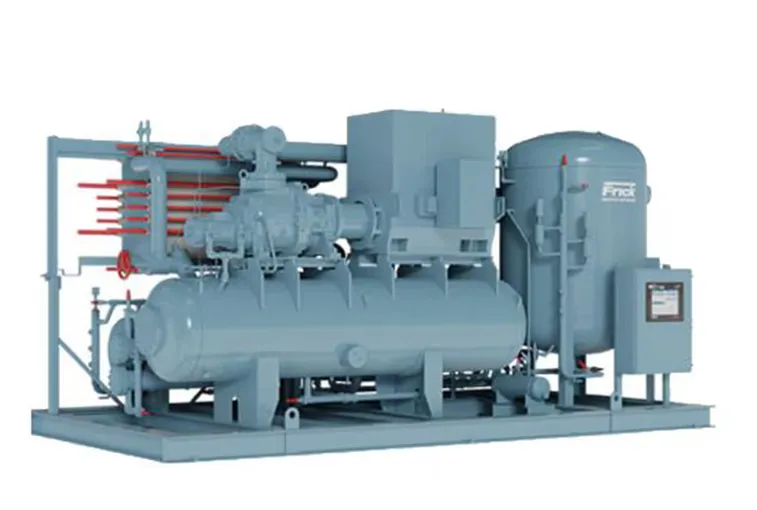
Johnson Controls has launched a Frick ammonia heat pump for food and beverage plants, with heating capacity from 200 kW to 2 MW.
Source:pv magazine USA
Post
Johnson Controls says its new ammonia heat pump reaches 2 MW
Ad
From The CircuitryVerified tech news, cross-checked.How we verify →
Ad
From The CircuitryWhy The Circuitry

Verified tech news, cross-checked.

Every story is checked against independent sources before it posts — no rumors dressed up as fact.

How we verify →
TL;DRAI · 60 sec read

Johnson Controls has launched the Frick HeatPAC reciprocating ammonia heat pump for food and beverage plants. Heating capacity runs from 200 kW to 2 MW, and the company says it can be up to seven times more efficient than a gas boiler in its own modeling.

Johnson Controls has launched an industrial ammonia heat pump for food and beverage plants. The report, published November 5, says the standardized unit recovers waste heat from ammonia refrigeration and can heat water to as high as 87.8 C.
It delivers heating capacity from 200 kW to 2 MW and hot water from 54.4 C to 87.8 C.
Capacity runs from 200 kW to 2 MW. The product is the Frick HeatPAC Reciprocating Ammonia Heat Pump. It delivers heating capacity from 200 kW to 2 MW and hot water from 54.4 C to 87.8 C. It uses ammonia, listed as R717, with a minimum refrigerant charge of about 39.5 kg.
From The CircuitryThe Feed — live briefs across tech, all day.See what’s happening →
The efficiency claim is the company's own modeling. Johnson Controls said the system can be up to seven times more energy efficient than a natural gas boiler in typical applications, based on internal modeling. The company has not disclosed a rated coefficient of performance, electrical input, unit dimensions, weight, or operating pressure limits.

The hardware is a packaged reciprocating unit. It uses a Mark 5 Sabroe reciprocating compressor and a fully welded plate-and-shell condenser with an integrated desuperheater. It has two-stage oil separation, a crankcase ventilation system, and a variable-frequency drive with a 4:1 turndown ratio. The factory-assembled units use a Frick Quantum HD controller with a 15-inch touchscreen.
Ad
From The CircuitryWhy The Circuitry

Verified tech news, cross-checked.

Every story is checked against independent sources before it posts — no rumors dressed up as fact.

How we verify →
The company says the standard design shortens delivery. Johnson Controls said the standardized design can reduce upfront investment costs and shorten delivery times by several weeks compared with engineered-to-order industrial heat pumps. It did not give a price or a delivery date. Micah Lehman, a product manager at Johnson Controls, said: "As energy costs continue to rise, waste heat is becoming an increasingly valuable and often untapped resource for food and beverage producers."
Why this mattersAI · ~100 words

Tap a lens to see what this story means for you.

Morning Brief

Liked this? The Brief brings you the whole day in tech, verified, every morning.

Two minutes, free forever. What's in The Brief →

Reader-supported
DonateBuy me a coffee →Follow@thecircuitry_ →Follow@thecircuitry.to →
HELP US IMPROVE
From The Circuitry

See what’s happening right now

The Feed runs all day — short, verified briefs the moment they break.

Open the Feed →
From The Circuitry

Follow @thecircuitry_

Every story we publish, as it happens. No noise between.

Follow on X ↗On Bluesky ↗

Reader-supported

The Circuitry is a passion project I've always wanted to build, and I love the work behind it.

Running it costs real money. APIs, hosting, time. To keep improving the site and growing this into something useful for everyone, those costs have to be covered.

Any contribution is appreciated. If not, no pressure. Thanks for reading.

Buy me a coffee
More inEnergy
  • U.S. energy storage capacity has passed 200 GWh

    Energy · 11d
  • PJM is filing a plan to cut interconnection studies from two years to one

    Energy · 12d
  • IEA says the oil market returns to a surplus this quarter

    Energy · 15d
SupportThe Work

The Circuitry is reader-supported. If you find the daily brief useful, you can buy me a coffee to keep it going.

Buy a coffee →
Ad
From The CircuitryWhy The Circuitry

Verified tech news, cross-checked.

Every story is checked against independent sources before it posts — no rumors dressed up as fact.

How we verify →
From The CircuitryWhy The Circuitry

Verified tech news, cross-checked.

Every story is checked against independent sources before it posts — no rumors dressed up as fact.

How we verify →

MORE IN THIS BEAT

All Energy →
  • Energy·Nov 26

    Eldridge-led group agrees to buy Lukoil's overseas energy assets

    A U.S.-led consortium including the Development Finance Corporation has agreed to acquire Lukoil's international energy assets through a share swap. The deal covers upstream output of about 350,000 barrels of oil equivalent per day, three refineries and more than 2,000 stations, and still needs conditional OFAC approval.

  • Energy·Nov 23

    ConocoPhillips agrees to sell its Norway business for $4.425 billion

    ConocoPhillips has agreed to sell its Norway business and its 40.25% Teesside terminal interest to Vår Energi for total consideration of $4.425 billion. After adjustments and a tax liability, total consideration is expected to be $3.9 billion, with about $2.5 billion in net cash proceeds.

  • Energy·Nov 22

    Boom fires its Superpower engine core for the first time

    Boom has fired the prototype core of its Superpower engine for the first time, in a Nov. 21 test east of Denver. The core is meant for a 42-megawatt gas turbine for data centers, with a fully integrated engine test aimed at the middle of next year.

  • Energy·Nov 20

    Meta is re-evaluating its 2030 net-zero emissions goal

    Meta is re-evaluating the 2030 timeframe for its net-zero emissions goal and its near-term intensity targets. Long-term ambitions are unchanged, and the company has contracts for more than 30 GW of clean and renewable power.

  • Energy·Nov 17

    SBM Offshore will build the Longtail FPSO for ExxonMobil Guyana

    SBM Offshore has been awarded contracts to construct and install the Longtail FPSO for ExxonMobil Guyana. The vessel is designed for 250,000 barrels of condensate a day, with gas processing of 1.2 billion standard cubic feet each day.