The Circuitry
THE CIRCUITRYYour one-stop source for all tech news
HOMETODAYNEWSFEEDEVENTS
BOOKMARKS
RSS
© 2026 The Circuitry
About UsSourcesContactCorrectionsPrivacy
  • Today
  • Feed
  • Events
  • Saved
Scroll for more
Verification
VERIFIEDConfidence: HIGH
Source identified
Claims cross-referenced
No discrepancies found
Fact-check summary

VentureBeat, Caixin Global, MarkTechPost and others confirm Meituan open-sourced its 1.6T-parameter LongCat-2.0 model in late June/early July 2026, trained entirely on Chinese chips and previously known as Owl Alpha.

Sourcing
1source

via DigiTimes Asia

DigiTimes Asia · track record
41Stories
100%Verified
630d
All sources →
Home/Tech/Meituan open-sources trillion-parameter LongCat-2.0
VERIFIEDBy Xavier Rivera· ·1 min read

Meituan open-sources trillion-parameter LongCat-2.0

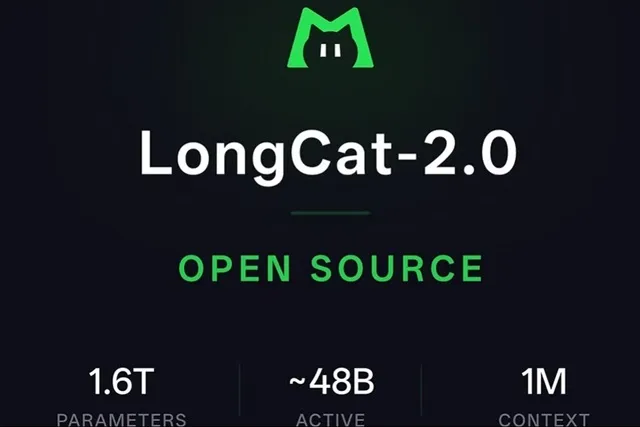
Meituan has open-sourced LongCat-2.0, a trillion-parameter AI model trained and deployed entirely on Chinese computing infrastructure. The release turns the former Owl Alpha project into a key test of China's domestic AI model and chip ecosystem.
Source:DigiTimes Asia
Post
Meituan open-sources trillion-parameter LongCat-2.0
TL;DRAI · 60 sec read

Meituan open-sources LongCat-2.0, a one-trillion-parameter AI model developed entirely on Chinese hardware and software. The July 8 release of the former Owl Alpha project serves as a benchmark for self-reliant systems at scale. It shows that large-scale models can operate without foreign technology and invites wider involvement from local researchers.

Meituan has open-sourced LongCat-2.0, a trillion-parameter AI model trained and deployed entirely on Chinese computing infrastructure.

Meituan releases LongCat-2.0 to the public. The food delivery and services giant made the trillion-parameter model available as open source on July 8, 2026. LongCat-2.0 was developed completely within China's domestic AI stack.
No foreign hardware or software components were involved in the core pipeline.

The release transforms the previously anonymous Owl Alpha project into a prominent benchmark. It now serves as a visible test case for the viability of locally built AI models and supporting hardware.

Model relies exclusively on domestic infrastructure. Training and deployment of LongCat-2.0 used only Chinese computing resources and chips. No foreign hardware or software components were involved in the core pipeline.
From The CircuitryThe Feed — live briefs across tech, all day.See what’s happening →

This approach aligns with broader national efforts to reduce dependence on overseas technology. The model's scale, at one trillion parameters, places it among the largest publicly disclosed Chinese AI systems.
LongCat-2.0 demonstrates that large-scale models can be built and run without reliance on restricted foreign platforms.

Release signals growing momentum in China's AI ecosystem. Meituan's move comes as domestic AI development accelerates amid supply chain and geopolitical constraints. LongCat-2.0 demonstrates that large-scale models can be built and run without reliance on restricted foreign platforms.
The open-sourcing invites wider participation from researchers and developers inside China. It positions the model as both a technical achievement and a strategic statement on self-reliant AI capabilities.
Why this mattersAI · ~100 words

Tap a lens to see what this story means for you.

Reader-supported
DonateBuy me a coffee →Follow@thecircuitry_ →Follow@thecircuitry.to →

Reader-supported · The Brief

Liked this? The Brief brings you the whole day in tech, verified, every morning. Two minutes, free forever.

HELP US IMPROVE
From The Circuitry

See what’s happening right now

The Feed runs all day — short, verified briefs the moment they break.

Open the Feed →
From The Circuitry

Follow @thecircuitry_

Every story we publish, as it happens. No noise between.

Follow on X ↗On Bluesky ↗

Reader-supported

The Circuitry is a passion project I've always wanted to build, and I love the work behind it.

Running it costs real money. APIs, hosting, time. To keep improving the site and growing this into something useful for everyone, those costs have to be covered.

Any contribution is appreciated. If not, no pressure. Thanks for reading.

Buy me a coffee
AIOpen SourceChina Tech
More fromDigiTimes Asia
  • Intel Ships First High-NA EUV Logic Product for Panther Lake

    Tech · 24d
  • LimX Dynamics Raises Nearly $200M Pre-IPO as It Prepares for Public Listing

    Tech · 24d
  • IBM Issues Rare Mid-Quarter Warning on AI Memory Shortage

    Tech · 24d
More inTech
  • Tesla and SpaceX confirm Terafab chip fab in Texas

    Tech · 1d
  • OpenAI Urges Federal Judge to Throw Out Apple's Trade Secrets Complaint

    Tech · 2d
  • Meta introduces Muse Code, its terminal-based coding agent

    Tech · 2d
SupportThe Work

The Circuitry is reader-supported. If you find the daily brief useful, you can buy me a coffee to keep it going.

Buy a coffee →
SubscribeCircuitry Brief

Liked this? The Brief brings you the whole day in tech, verified, every morning. Free forever.

MORE IN TECH

Tesla and SpaceX confirm Terafab chip fab in Texas

Tesla and SpaceX have confirmed Grimes County, Texas as the site for their Terafab semiconductor megafactory, with the first phase costing roughly $16.8 billion. The project targets the largest chip manufacturing facility on the planet to supply over 1 terawatt of compute per year that exceeds current and future global production capacity.

OpenAI Urges Federal Judge to Throw Out Apple's Trade Secrets Complaint

OpenAI has filed a motion asking a federal judge to dismiss Apple's trade secrets lawsuit, describing the claims as meritless. The dispute, which follows a July suit and this week's injunction request from Apple, highlights tensions after their prior partnership on Siri and OpenAI's hardware push.

Meta introduces Muse Code, its terminal-based coding agent

Meta has released an early beta of Muse Code, a terminal-based coding agent driven by the updated Muse Spark 1.2 model and positioned against Anthropic's Claude Code and OpenAI's Codex. Substantially lower rates, including a contributor plan at $0.10 for every million tokens received, may encourage migration away from higher-priced options such as Anthropic's Sonnet 5.