The Circuitry
THE CIRCUITRYYour one-stop source for all tech news
HOMETODAYNEWSFEEDEVENTS
BOOKMARKS
RSS
© 2026 The Circuitry
About UsSourcesContactCorrectionsPrivacy
  • Today
  • Feed
  • Events
  • Saved
Scroll for more
Verification
VERIFIEDConfidence: HIGH
Source identified
Claims cross-referenced
No discrepancies found
1 discrepancy flagged
  • ▲Ars Technica source URL appears invalid or does not match any published article (primary reporting from Reuters and others on May 27, 2026); minor unconfirmed details include exact US infrastructure projection of 'half a trillion dollars' and direct comment on Trump tensions
Sourcing
1source

via Ars Technica

Ars Technica · track record
30Stories
100%Verified
130d
All sources →
Markets
NVDA···

Live quote · not investment advice

From The CircuitryWhy The Circuitry

Verified tech news, cross-checked.

Every story is checked against independent sources before it posts — no rumors dressed up as fact.

How we verify →
Home/Tech/Nvidia to Invest $150B Annually in Taiwan AI Epicenter
VERIFIEDBy Xavier Rivera· ·2.5 min read

Nvidia to Invest $150B Annually in Taiwan AI Epicenter

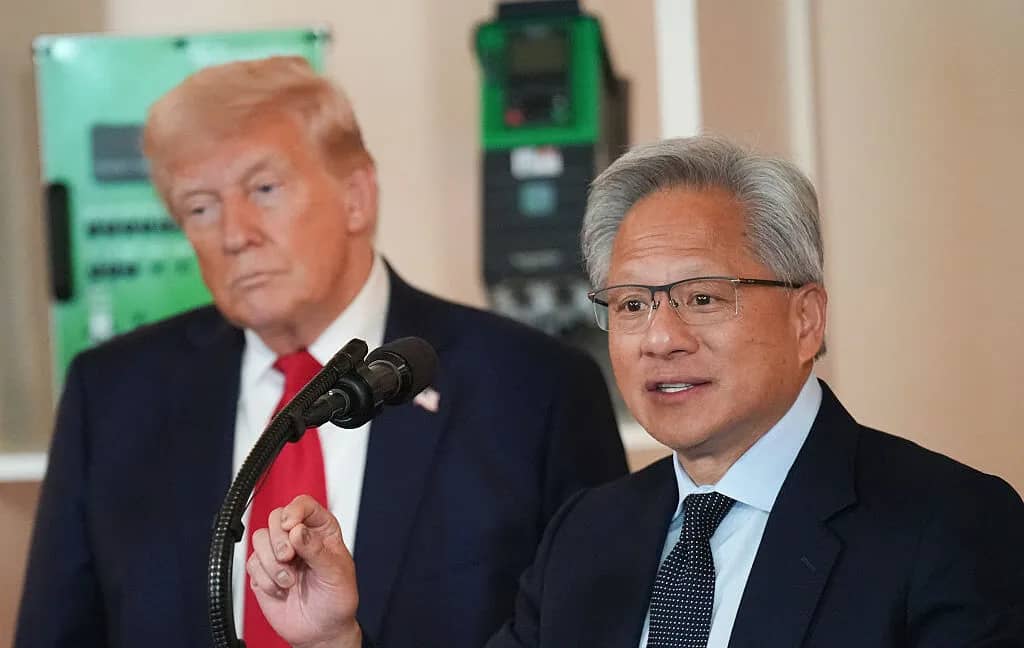
Nvidia will invest $150 billion annually to establish a new Taiwan headquarters and position the island as the epicenter of the AI revolution. The announcement highlights Taiwan's ongoing central role in AI chip production and packaging even as the company has begun limited US manufacturing.
Source:Ars Technica
Post
Nvidia to Invest $150B Annually in Taiwan AI Epicenter
From The CircuitryWhy The Circuitry

Verified tech news, cross-checked.

Every story is checked against independent sources before it posts — no rumors dressed up as fact.

How we verify →
TL;DRAI · 60 sec read

Nvidia CEO Jensen Huang announces 150 billion dollars in yearly investments to turn Taiwan into the AI revolution's hub with a new headquarters by 2030. Spending rises from 100 billion to 150 billion annually. The plans boost Taiwan's role in AI manufacturing amid US pushes for domestic production.

Nvidia CEO Jensen Huang announced that the company will invest $150 billion a year to make Taiwan the epicenter of the AI revolution. "This is where the chips come, packaging comes, this is where the systems are made, this is where AI supercomputers were created," Huang said. "The number of partners we work with here in Taiwan, incredible."

The substantial investments will create a new Taiwan headquarters for Nvidia. Huang expects the project to drive AI innovation that cements Taiwan as the world's tech manufacturing hub for a long time. The headquarters will be operational by 2030 after breaking ground this year.
Nvidia is currently the world's most valuable company after becoming the first to reach a $5 trillion market capitalization in 2025.

Four years ago and five years ago, Nvidia was spending about 10 to 15 billion dollars a year in Taiwan. The company is now spending 100 billion and is going to 150 billion dollars in Taiwan each year. Nvidia is currently the world's most valuable company after becoming the first to reach a $5 trillion market capitalization in 2025. Huang said the Taiwan base will make sure Nvidia is worth even more in three to five years.

Huang has not explained how Nvidia's plans in Taiwan may potentially conflict with Donald Trump's push to make the US the world's AI hub. Nvidia did not immediately respond to a request for comment on the seeming tension.
From The CircuitryThe Feed — live briefs across tech, all day.See what’s happening →

Last April, Nvidia started producing AI chips on US soil for the first time. The move was designed to appease Trump, who had been pressuring US firms to increase domestic manufacturing as a top priority of his AI Action Plan. At that time, Huang said that the engines of the world's AI infrastructure are being built in the United States for the first time because adding American manufacturing helps better meet the incredible and growing demand for AI chips and supercomputers, strengthens the supply chain, and boosts resiliency.
Huang has not explained how Nvidia's plans in Taiwan may potentially conflict with Donald Trump's push to make the US the world's AI hub.

Over the next four years, Nvidia projected it could produce up to half a trillion dollars of AI infrastructure in the US. The company has continued to rely on shipping chips to Taiwan for advanced packaging. Huang is now prioritizing more investments and deepening partnerships in Taiwan at a time when overwhelming demand for agentic AI is accelerating AI factory buildouts at extraordinary speed.
From The CircuitryWhy The Circuitry

Verified tech news, cross-checked.

Every story is checked against independent sources before it posts — no rumors dressed up as fact.

How we verify →
Tech giants collectively plan to spend $750 billion on AI infrastructure this year, with a significant portion expected to go towards chips for data centers. Nvidia is also preparing its new AI system Vera Rubin, which Huang claimed would be a generational leap kicking off the greatest infrastructure buildout in history. The company fears it will face supply chain constraints throughout the entire life of Vera Rubin. Before Trump's AI Action Plan rolled out, Nvidia had manufactured all its AI chips exclusively in Taiwan. With the Taiwan HQ, Nvidia hopes to expand its partnership with the Taiwan Semiconductor Manufa.
Why this mattersAI · ~100 words

Tap a lens to see what this story means for you.

Morning Brief

Liked this? The Brief brings you the whole day in tech, verified, every morning.

Two minutes, free forever. What's in The Brief →

Reader-supported
DonateBuy me a coffee →Follow@thecircuitry_ →Follow@thecircuitry.to →
HELP US IMPROVE
From The Circuitry

See what’s happening right now

The Feed runs all day — short, verified briefs the moment they break.

Open the Feed →
From The Circuitry

Follow @thecircuitry_

Every story we publish, as it happens. No noise between.

Follow on X ↗On Bluesky ↗

Reader-supported

The Circuitry is a passion project I've always wanted to build, and I love the work behind it.

Running it costs real money. APIs, hosting, time. To keep improving the site and growing this into something useful for everyone, those costs have to be covered.

Any contribution is appreciated. If not, no pressure. Thanks for reading.

Buy me a coffee
NvidiaAITaiwan
More fromArs Technica
  • Vendors object to Spirit Airlines selling operational data to Google in bankruptcy

    Tech · 28d
  • Twitch adds opt-out for Amazon’s generative AI training on user content

    Tech · 1mo
  • Aptoide becomes first rival app store hosted in Google Play

    Tech · 1mo
More inTech
  • GlobalFoundries signs $2B TSMC deal for US silicon interposers

    Tech · 8h
  • SpaceX agrees to buy 800 MHz spectrum for Starlink Mobile

    Tech · 11h
  • Microsoft discloses CVE-2026-83947 in Azure Event Grid

    Tech · 11h
SupportThe Work

The Circuitry is reader-supported. If you find the daily brief useful, you can buy me a coffee to keep it going.

Buy a coffee →
From The CircuitryWhy The Circuitry

Verified tech news, cross-checked.

Every story is checked against independent sources before it posts — no rumors dressed up as fact.

How we verify →

MORE IN THIS BEAT

All Tech →
  • Tech· 

    Microsoft opens Surface Laptop Ultra preorders and pushes AI agents deeper into Windows

    At its Windows and Surface event, Microsoft opened preorders for the $2,599 Surface Laptop Ultra and the $5,999 Surface RTX Spark Dev Box, and said Copilot will be able to use files and act across Windows in the coming months.

  • Tech· 

    NVIDIA, Microsoft Open RTX Spark Preorders and Push AI Agents on Windows PCs

    NVIDIA and Microsoft opened RTX Spark preorders and made Microsoft Execution Containers generally available at the Windows AI and Surface event, aimed at running AI agents on Windows PCs. RTX Spark laptops, first introduced in June, are on preorder today with up to 128 GB unified memory and one petaflop of AI compute, shipping October 16.

  • Tech· 

    Anthropic Launches Cyber Mission to Secure Infrastructure and Open-Source Code

    Anthropic has launched the Anthropic Cyber Mission to support defenders of critical infrastructure and open-source software with models, engineers, and tools. The initiative starts with the Critical Infrastructure Defense Program and free OSS Scanner amid ongoing challenges in verifying and fixing vulnerabilities.

  • Tech· 

    First Nvidia RTX Spark laptops range from $2,599 to nearly $7,000

    The first laptops built on Nvidia's RTX Spark chip, from Microsoft, Asus, Dell, HP, Lenovo and MSI, start at $2,599 and climb to $6,999.99 for a maxed-out Asus ProArt P16 with 128GB of unified memory, The Verge reports. The first models ship as early as October 16.

  • Tech· 

    Anthropic launches Claude Haiku 5.5, cutting prices up to 90% from Haiku 4.5

    Anthropic released Claude Haiku 5.5, its cheapest and fastest small model, at $0.10 per million input tokens and $0.50 per million output tokens for prompts up to 100,000 tokens. Anthropic says it costs around 75% less to run than Haiku 4.5 on average and scores far higher on its benchmarks.