The Circuitry
THE CIRCUITRYYour one-stop source for all tech news
HOMETODAYNEWSFEEDEVENTS
BOOKMARKS
RSS
© 2026 The Circuitry
About UsSourcesContactCorrectionsPrivacy
  • Today
  • Feed
  • Events
  • Saved
Scroll for more
Verification
VERIFIEDConfidence: HIGH
Source identified
Claims cross-referenced
No discrepancies found
Fact-check summary

Meta's official blog and CNBC confirm the Muse Code beta release today with Muse Spark 1.2, matching the core details on capabilities, pricing, and Wang quotes.

Sourcing
1source

via Engadget

Engadget · track record
37Stories
100%Verified
1030d
All sources →
Markets
META···

Live quote · not investment advice

From The CircuitryWhy The Circuitry

Verified tech news, cross-checked.

Every story is checked against independent sources before it posts — no rumors dressed up as fact.

How we verify →
Home/Tech/Meta introduces Muse Code, its terminal-based coding agent
VERIFIEDBy Xavier Rivera· ·1.5 min read

Meta introduces Muse Code, its terminal-based coding agent

Meta has released an early beta of Muse Code, a terminal-based coding agent driven by the updated Muse Spark 1.2 model and positioned against Anthropic's Claude Code and OpenAI's Codex. Substantially lower rates, including a contributor plan at $0.10 for every million tokens received, may encourage migration away from higher-priced options such as Anthropic's Sonnet 5.
Source:Engadget
Post
Meta introduces Muse Code, its terminal-based coding agent
From The CircuitryWhy The Circuitry

Verified tech news, cross-checked.

Every story is checked against independent sources before it posts — no rumors dressed up as fact.

How we verify →
TL;DRAI · 60 sec read

Meta introduces Muse Code, an early beta terminal-based coding agent aimed at Anthropic's Claude Code and OpenAI's Codex. Powered by Muse Spark 1.2, it completes full software projects from text commands and manages sub-agents. Its low pricing at $1.25 per million input tokens could shift enterprise adoption from costlier competitors.

Meta has released an early beta version of Muse Code, a terminal-based coding agent targeting Anthropic's Claude Code and OpenAI's Codex. The new tool runs on Muse Spark 1.2, an updated edition of the company's AI system that reportedly delivers "improvements in code generation, complex debugging, codebase understanding, and end-to-end developer workflows."
Muse Spark 1.2 coding capabilities improvement chart
Muse Spark 1.2 coding capabilities improvement chart · AI at Meta
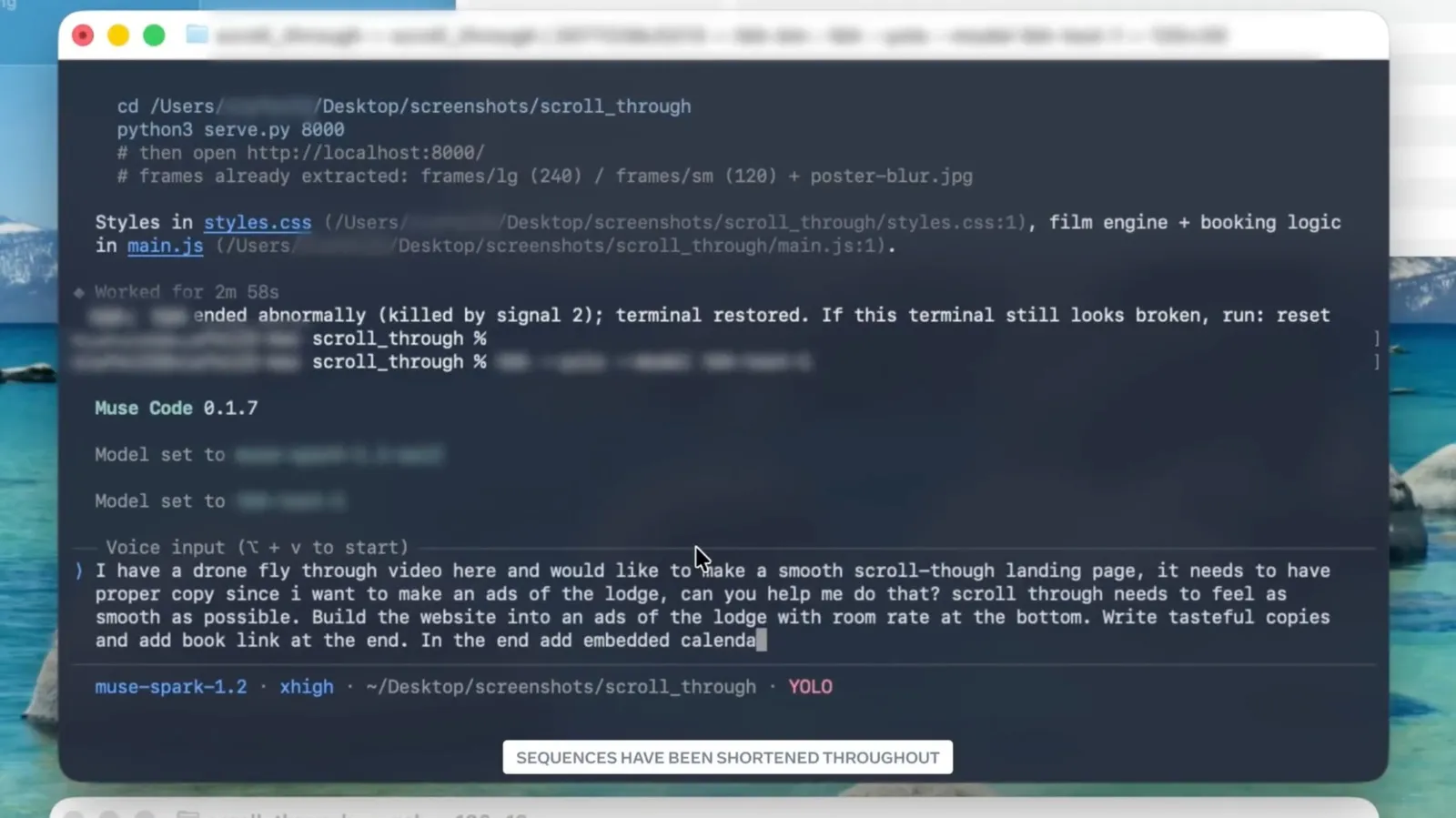
Muse Code manages complete software engineering jobs through plain text instructions. The system writes code, maps out modifications, checks outcomes and supports construction of functional programs. It additionally coordinates several sub-agents while assigning duties to speed up delivery.
Muse Code manages complete software engineering jobs through plain text instructions.
Meta highlighted demonstration projects that include an interactive photon sphere simulation plus a Plants vs. Zombies-style clone. A video walkthrough depicts the agent creating a full webpage from an MP4 video clip.
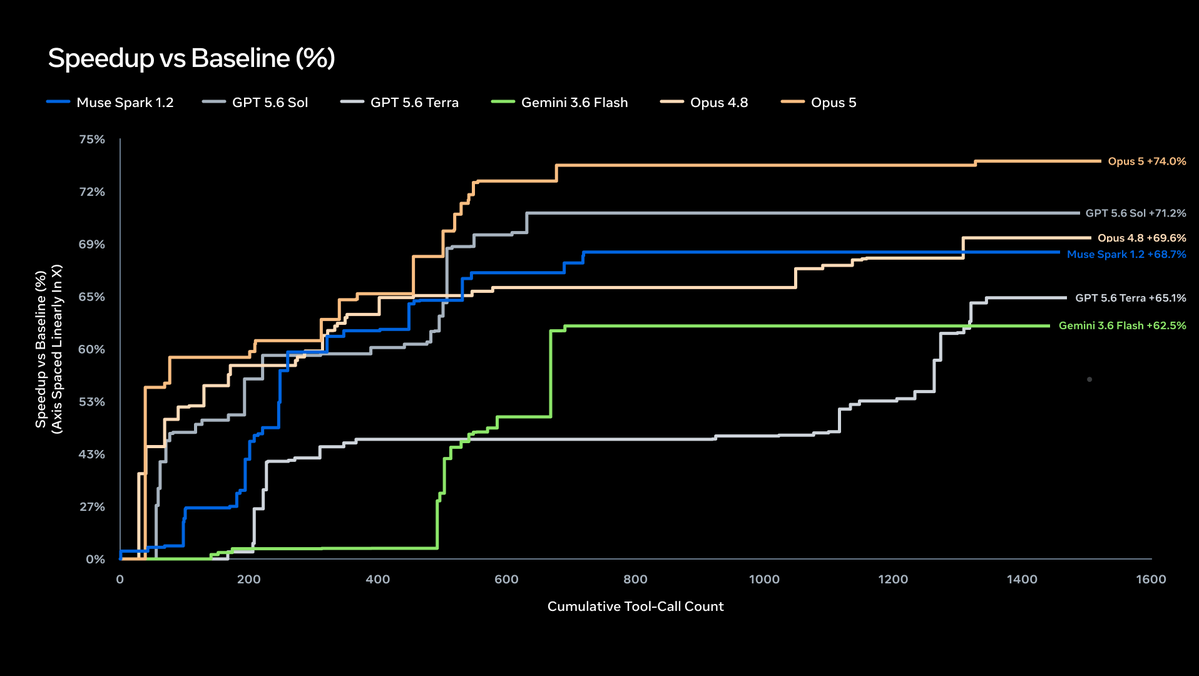
Long-horizon GPU kernel optimization benchmark results for Muse Code
Long-horizon GPU kernel optimization benchmark results for Muse Code · AI at Meta
Affordability forms a central distinction against rival offerings. By default Muse Code follows the same usage-based rates as Muse Spark, set at $1.25 for every million tokens received and $4.25 for every million tokens produced. According to The Wall Street Journal, a contributor tier charging $0.10 for every million tokens received and $0.20 for every million tokens produced will be available to those who consent to supplying feedback that refines the agent. In a CNBC interview, Meta Chief AI Officer Alexander Wang described the tier as one that gets participants "in at a significantly lower cost."
From The CircuitryThe Feed — live briefs across tech, all day.See what’s happening →
These figures sit well below Anthropic's Sonnet 5 model, which generally runs $3 for every million tokens received and $15 for every million tokens produced. Should the tool deliver strong results, enterprises may migrate toward Meta. Comparable economics have already prompted numerous firms to adopt Chinese models such as DeepSeek instead of increasingly expensive American alternatives.
Comparable economics have already prompted numerous firms to adopt Chinese models such as DeepSeek instead of increasingly expensive American alternatives.
POST FROM @AIatMeta· official announcement tweet from Meta's AI account linking directly to the Muse Code / Muse Spark 1.2 release
https://x.com/AIatMeta/status/2085084720266641755
From The CircuitryWhy The Circuitry

Verified tech news, cross-checked.

Every story is checked against independent sources before it posts — no rumors dressed up as fact.

How we verify →
Why this mattersAI · ~100 words

Tap a lens to see what this story means for you.

Morning Brief

Liked this? The Brief brings you the whole day in tech, verified, every morning.

Two minutes, free forever. What's in The Brief →

Reader-supported
DonateBuy me a coffee →Follow@thecircuitry_ →Follow@thecircuitry.to →
HELP US IMPROVE
From The Circuitry

See what’s happening right now

The Feed runs all day — short, verified briefs the moment they break.

Open the Feed →
From The Circuitry

Follow @thecircuitry_

Every story we publish, as it happens. No noise between.

Follow on X ↗On Bluesky ↗

Reader-supported

The Circuitry is a passion project I've always wanted to build, and I love the work behind it.

Running it costs real money. APIs, hosting, time. To keep improving the site and growing this into something useful for everyone, those costs have to be covered.

Any contribution is appreciated. If not, no pressure. Thanks for reading.

Buy me a coffee
AIMetaCoding
More fromEngadget
  • Microsoft Turns Windows Task Bar Search Into AI Chatbot This Fall

    Tech · 1d
  • OpenAI launches $500 Pro tier and GPT-6.1 Sol at DevDay

    Tech · 9d
  • California Bans Public Officials From Issuing Memecoins

    Markets · 10d
More inTech
  • GlobalFoundries signs $2B TSMC deal for US silicon interposers

    Tech · 8h
  • SpaceX agrees to buy 800 MHz spectrum for Starlink Mobile

    Tech · 11h
  • Microsoft discloses CVE-2026-83947 in Azure Event Grid

    Tech · 11h
SupportThe Work

The Circuitry is reader-supported. If you find the daily brief useful, you can buy me a coffee to keep it going.

Buy a coffee →
From The CircuitryWhy The Circuitry

Verified tech news, cross-checked.

Every story is checked against independent sources before it posts — no rumors dressed up as fact.

How we verify →

MORE IN THIS BEAT

All Tech →
  • Tech· 

    Meta and Microsoft Slash Employee Claude AI Spending

    Meta and Microsoft are cutting employee use of Anthropic’s Claude AI and directing staff toward their own coding tools, The Information reported. The changes reflect tighter internal AI budgets while customer access to Claude through Microsoft platforms continues to expand.

  • Tech· 

    Google DeepMind and Meta back Biohub virtual cell with $300M

    Google DeepMind, Meta, and Isomorphic Labs are investing $300 million in Biohub to build AI datasets for a virtual cell model. The funding is part of a $1.8 billion initiative that also includes contributions from the Department of Energy and National Institutes of Health.

  • Tech· 

    Anthropic Launches Cyber Mission to Secure Infrastructure and Open-Source Code

    Anthropic has launched the Anthropic Cyber Mission to support defenders of critical infrastructure and open-source software with models, engineers, and tools. The initiative starts with the Critical Infrastructure Defense Program and free OSS Scanner amid ongoing challenges in verifying and fixing vulnerabilities.

  • Tech· 

    Anthropic launches Claude Haiku 5.5, cutting prices up to 90% from Haiku 4.5

    Anthropic released Claude Haiku 5.5, its cheapest and fastest small model, at $0.10 per million input tokens and $0.50 per million output tokens for prompts up to 100,000 tokens. Anthropic says it costs around 75% less to run than Haiku 4.5 on average and scores far higher on its benchmarks.

  • Tech· 

    OpenAI publishes 722 math manuscripts from an unreleased internal model

    OpenAI released 722 mathematical manuscripts, grouped into 372 result families, produced by an unreleased internal model. The papers are on GitHub, with Lean formalizations for many but not all of them, and OpenAI warns some unformalized results could have issues.