The Circuitry
THE CIRCUITRYYour one-stop source for all tech news
HOMETODAYNEWSFEEDEVENTS
BOOKMARKS
RSS
© 2026 The Circuitry
About UsSourcesContactCorrectionsPrivacy
  • Today
  • Feed
  • Events
  • Saved
Scroll for more
Verification
VERIFIEDConfidence: HIGH
Source identified
Claims cross-referenced
No discrepancies found
Sourcing
1source

via Ars Technica

Ars Technica · track record
27Stories
100%Verified
230d
All sources →
Home/Tech/Roku OS Home Screen Overhauled With Large Permanent Ad
VERIFIEDBy Xavier Rivera· ·3 min read

Roku OS Home Screen Overhauled With Large Permanent Ad

Roku has rolled out its largest smart TV OS overhaul in a decade, dedicating a large permanent ad space to the right side of the home screen that stays visible during navigation. The redesign supports the company's advertising-driven return to profitability after a multi-year gap.
Source:Ars Technica
Post
Roku OS Home Screen Overhauled With Large Permanent Ad
TL;DRAI · 60 sec read

Roku rolls out its largest operating system update in ten years. The home screen now features a prominent permanent advertisement on the right side that stays visible during navigation. Additional changes include personalized content picks and AI-suggested apps. The redesign aims to grow advertising income, which helps offset losses from hardware sales.

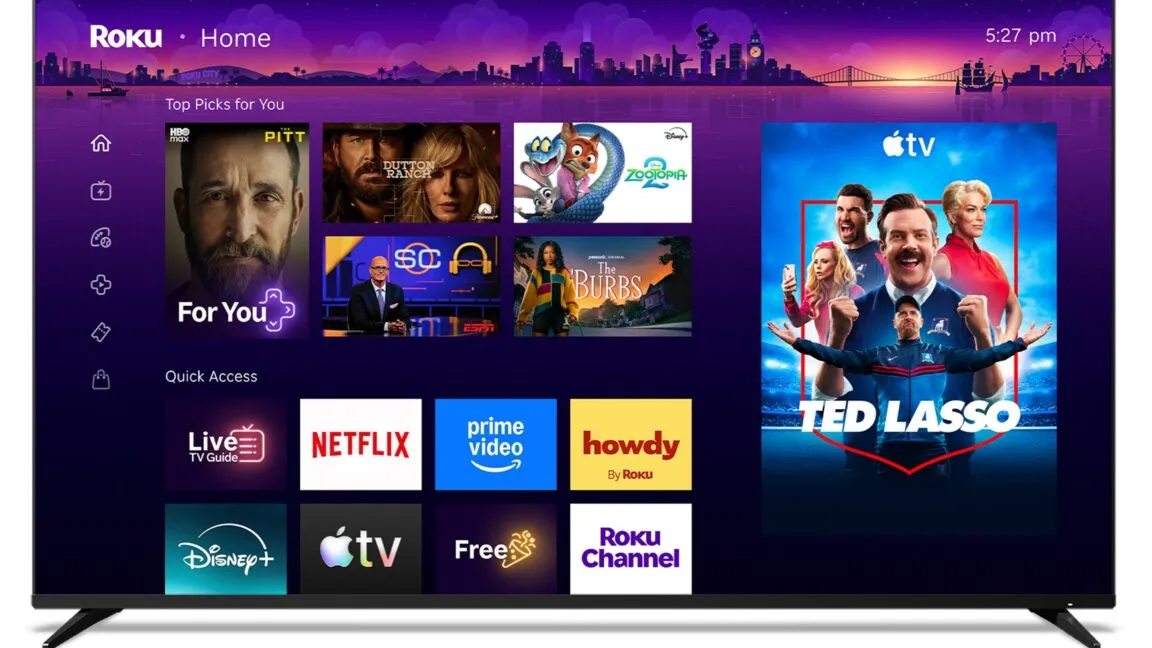
Roku has unveiled the biggest overhaul to its smart TV operating system in 10 years, with the most noticeable change being a new ad space that takes up a large chunk of the screen’s right side.

Before the update, the Roku OS home screen featured a menu on the left side with sections including “What to Watch,” “Live,” and “Search.” The right side displayed a row of tiles for “Recommended” content above several rows of tiles representing downloaded apps. In the new design, the right side is dedicated to ads. The ad remains visible as users navigate different parts of the Roku menu, reducing space that could be used for displaying apps and content.
The ad remains visible as users navigate different parts of the Roku menu, reducing space that could be used for displaying apps and content.

The marquee ad space can show marketing for a TV show or movie available to stream, such as an ad for the Apple TV+ show Ted Lasso in an image shared by Roku. It could also display a regular, possibly unrelated advertisement. CNET reported seeing a demonstration with an ad for The Farmer’s Dog dog food in the space. CNET, citing a discussion with Preston Smalley, VP of viewer product at Roku, reported that the proportion of each type of ad—paid or programmed—wasn’t set and could change.
POST FROM @Roku· official announcement tweet with video demo of the new home screen
https://x.com/Roku/status/2059636215012356459

The home screen changes tie to Roku’s efforts to maintain profitability. The company first reached annual profitability in 2021, largely due to people staying at home during the pandemic. It did not see annual profitability again until 2025, when its finances were buoyed by growth in advertising revenue. In its most recent earnings report, Roku made $371 million in advertising revenue. Its Platform business, which includes advertising and subscriptions, posted a gross profit of $584.1 million. Roku’s devices business lost $19.1 million. Total gross profit was $564.9 million.
From The CircuitryThe Feed — live briefs across tech, all day.See what’s happening →

In a February earnings call, Roku CEO Anthony Wood said that he thinks the new home screen, which was in testing at the time, would “increase monetization over time, whether that’s getting viewers to sign up for subscriptions or watch more ad-supported content.”
Plastering ads for shit you think I want to see is the fastest way to get me to not watch it.

Additional changes include a slimmer left sidebar menu with images replacing text. In the center are tiles for “Top Picks for You” above rows for “Quick Access.” The former is a personalized row that makes recommendations and highlights trending and relevant content based on user interest, where no two people will see the same mix. Quick Access uses AI to show users’ most-used apps and shortcuts. Smalley told Fast Company that not very many people actually customized those app screens and would end up scrolling to the bottom of a long list, so the update pulls that together in a way that makes sense.
The update also adds a section called Destinations, which Roku described as curated hubs that span genres and moods, such as comedies, sports, and movies, with content across different streaming services. Some users have reacted negatively. One apparent Roku user posting as Kruse on Reddit wrote, “I don’t want recommendations! I know what I want to watch. Plastering ads for shit you think I want to see is the fastest way to get me to not watch it. This is going to suck.” The update does not include an easy way to select recently viewed content from across apps on the home screen.
Why this mattersAI · ~100 words

Tap a lens to see what this story means for you.

Reader-supported
DonateBuy me a coffee →Follow@thecircuitry_ →Follow@thecircuitry.to →

Reader-supported · The Brief

Liked this? The Brief brings you the whole day in tech, verified, every morning. Two minutes, free forever.

HELP US IMPROVE
From The Circuitry

See what’s happening right now

The Feed runs all day — short, verified briefs the moment they break.

Open the Feed →
From The Circuitry

Follow @thecircuitry_

Every story we publish, as it happens. No noise between.

Follow on X ↗On Bluesky ↗

Reader-supported

The Circuitry is a passion project I've always wanted to build, and I love the work behind it.

Running it costs real money. APIs, hosting, time. To keep improving the site and growing this into something useful for everyone, those costs have to be covered.

Any contribution is appreciated. If not, no pressure. Thanks for reading.

Buy me a coffee
RokuStreamingSmart TVAdvertising
More fromArs Technica
  • Samsung debuts its first wide-body foldable in 2026 Galaxy Z8 lineup

    Tech · 17d
  • Microsoft Secure Boot bypassed for 13 years via unrevoked shims

    Tech · 24d
  • Blue Origin reportedly raising up to $10B in first private capital round

    Tech · 1mo
More inTech
  • Tesla and SpaceX confirm Terafab chip fab in Texas

    Tech · 1d
  • OpenAI Urges Federal Judge to Throw Out Apple's Trade Secrets Complaint

    Tech · 2d
  • Meta introduces Muse Code, its terminal-based coding agent

    Tech · 2d
SupportThe Work

The Circuitry is reader-supported. If you find the daily brief useful, you can buy me a coffee to keep it going.

Buy a coffee →
SubscribeCircuitry Brief

Liked this? The Brief brings you the whole day in tech, verified, every morning. Free forever.

MORE IN TECH

Tesla and SpaceX confirm Terafab chip fab in Texas

Tesla and SpaceX have confirmed Grimes County, Texas as the site for their Terafab semiconductor megafactory, with the first phase costing roughly $16.8 billion. The project targets the largest chip manufacturing facility on the planet to supply over 1 terawatt of compute per year that exceeds current and future global production capacity.

OpenAI Urges Federal Judge to Throw Out Apple's Trade Secrets Complaint

OpenAI has filed a motion asking a federal judge to dismiss Apple's trade secrets lawsuit, describing the claims as meritless. The dispute, which follows a July suit and this week's injunction request from Apple, highlights tensions after their prior partnership on Siri and OpenAI's hardware push.

Meta introduces Muse Code, its terminal-based coding agent

Meta has released an early beta of Muse Code, a terminal-based coding agent driven by the updated Muse Spark 1.2 model and positioned against Anthropic's Claude Code and OpenAI's Codex. Substantially lower rates, including a contributor plan at $0.10 for every million tokens received, may encourage migration away from higher-priced options such as Anthropic's Sonnet 5.