The Circuitry
THE CIRCUITRYYour one-stop source for all tech news
HOMETODAYNEWSFEEDEVENTS
BOOKMARKS
RSS
© 2026 The Circuitry
About UsSourcesContactCorrectionsPrivacy
  • Today
  • Feed
  • Events
  • Saved
Scroll for more
Verification
VERIFIEDConfidence: HIGH
Source identified
Claims cross-referenced
No discrepancies found
Fact-check summary

Multiple outlets including Forbes, Al Jazeera, The Guardian, and CBS News confirm the Trump AI safety self-regulation accord signed by Pichai, Amodei, Zuckerberg, Brockman, Musk, and Huang.

Sourcing
1source

via The Verge

The Verge · track record
117Stories
100%Verified
2330d
All sources →
From The CircuitryWhy The Circuitry

Verified tech news, cross-checked.

Every story is checked against independent sources before it posts — no rumors dressed up as fact.

How we verify →
Home/Tech/Tech leaders sign Trump’s AI safety self-regulation accord
VERIFIEDBy Xavier Rivera· ·1.5 min read

Tech leaders sign Trump’s AI safety self-regulation accord

Six tech executives signed President Trump’s Joint Commitment On Frontier Responsibilities, a voluntary AI safety pact with four internal oversight rules. The agreement contains no penalties and notes that the steps could later become law.
Source:The Verge
Post
Tech leaders sign Trump’s AI safety self-regulation accord
From The CircuitryWhy The Circuitry

Verified tech news, cross-checked.

Every story is checked against independent sources before it posts — no rumors dressed up as fact.

How we verify →
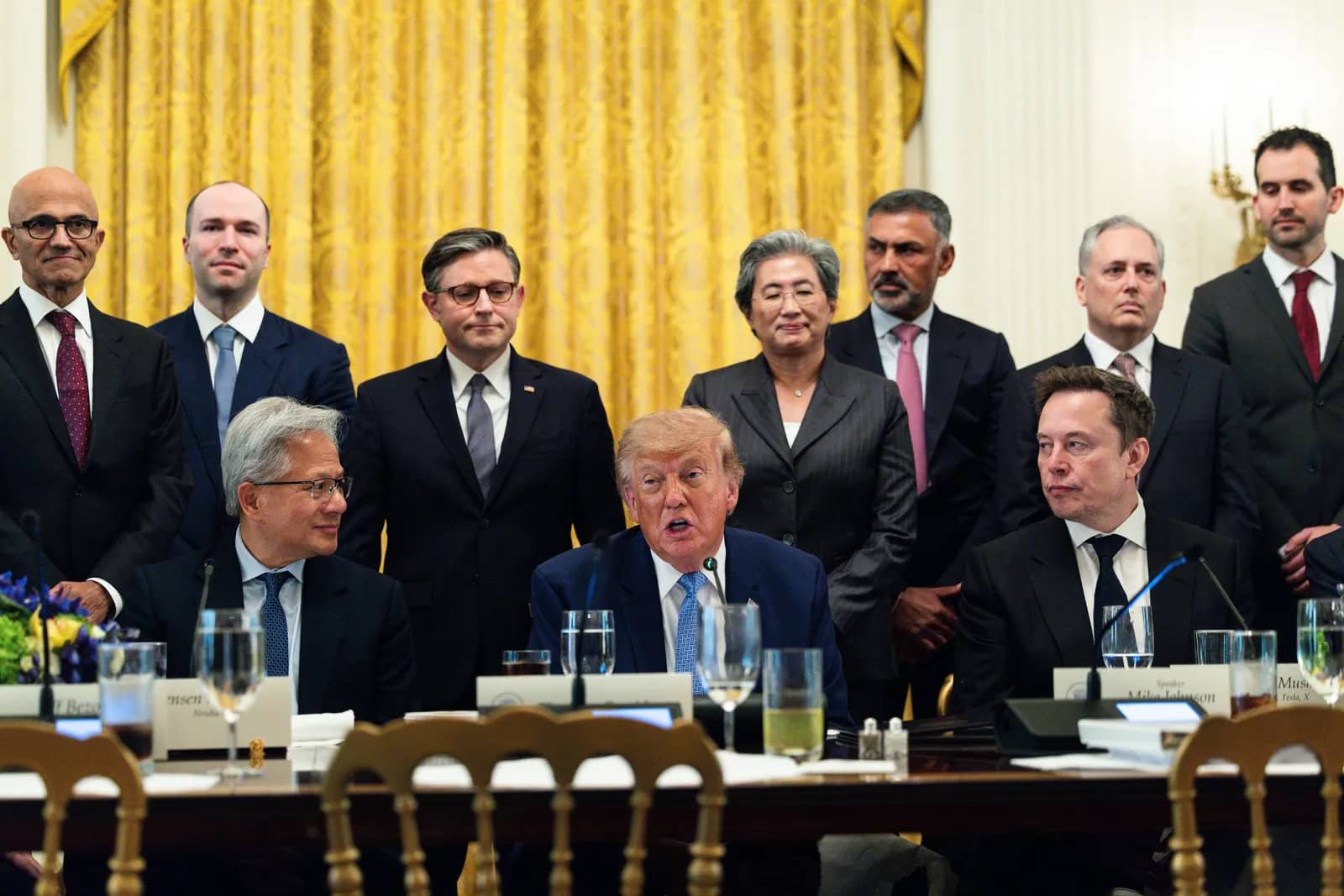
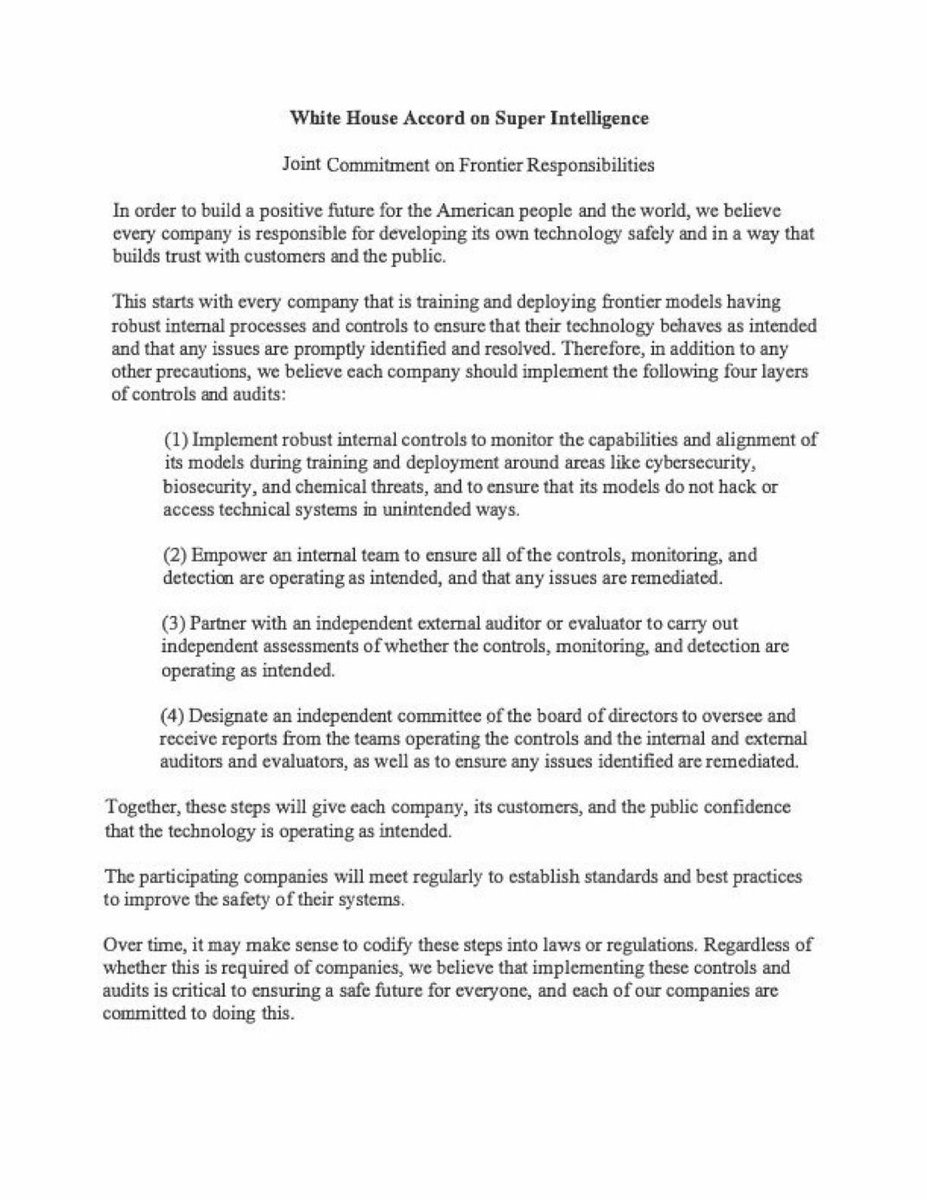
Tech executives from six major companies have signed a “morally binding” AI safety agreement announced by President Trump. The document, titled the Joint Commitment On Frontier Responsibilities, outlines voluntary internal measures for frontier AI models.
Group photo of tech leaders and President Trump at the White House AI safety accord signing
Group photo of tech leaders and President Trump at the White House AI safety accord signing · David Sacks / X
David Sacks shared the signed accord online. The agreement lists signatories including Google’s Sundar Pichai, Anthropic’s Dario Amodei, Meta’s Mark Zuckerberg, OpenAI’s Greg Brockman, xAI’s Elon Musk, and Nvidia’s Jensen Huang. President Trump added his own signature with the title “President of the Unites States.”
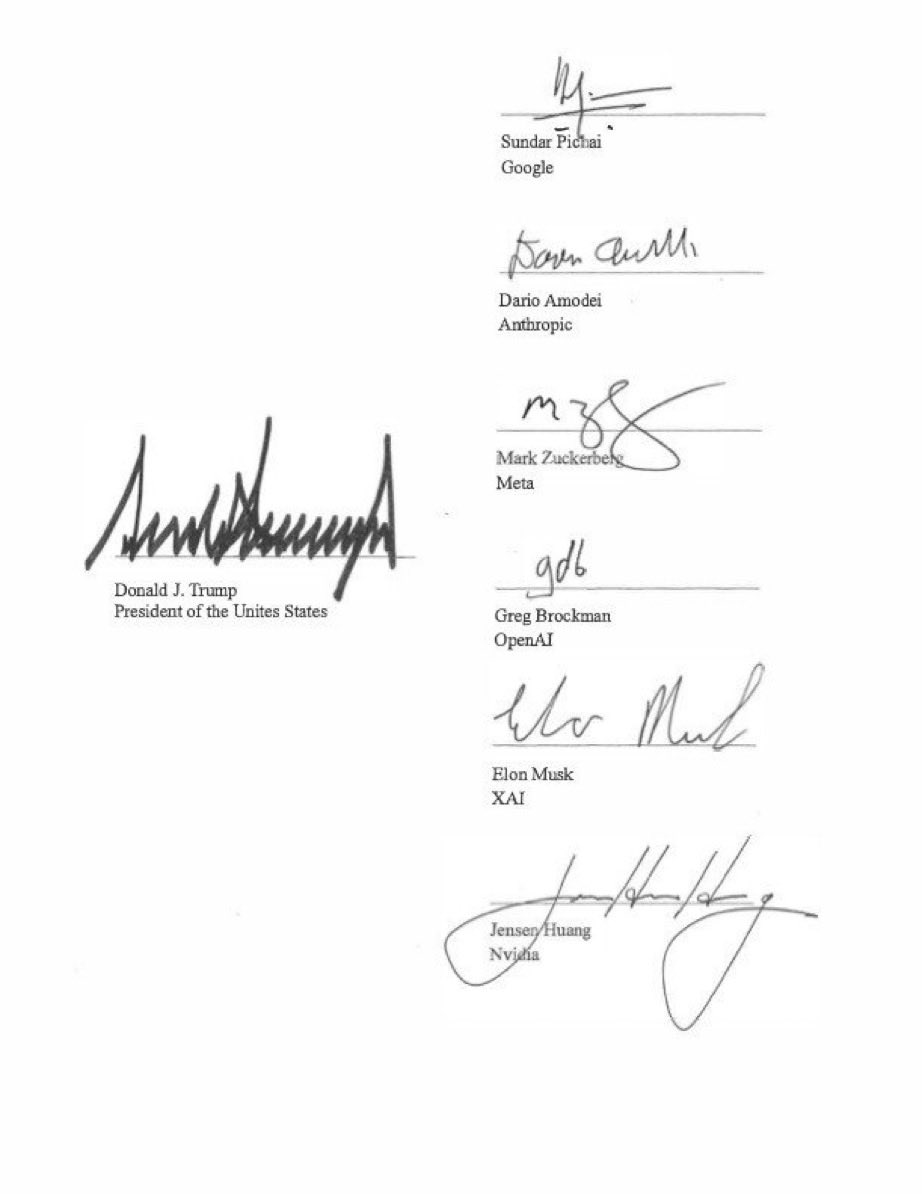
President Trump added his own signature with the title “President of the Unites States.”
The document sets four specific rules for participating companies. Each firm must implement internal controls to monitor model capabilities and alignment during training and deployment, focusing on cybersecurity, biosecurity, and chemical threats. Companies must also empower an internal team to verify controls and remediate issues.
Group photo of tech leaders and President Trump at the White House AI safety accord signing
Group photo of tech leaders and President Trump at the White House AI safety accord signing · David Sacks / X
Independent oversight forms the third and fourth rules. Firms are required to partner with an external auditor or evaluator for assessments of controls and detection systems. An independent board committee must oversee reports from internal teams and auditors while ensuring remediation of identified problems.
POST FROM @DavidSacks· official sharing of the accord document and announcement of the White House signing event referenced in the article
https://x.com/DavidSacks/status/2105060520327786914
The agreement includes a note on potential future regulation. A passage states that “over time, it may make sense to codify these steps into laws or regulations.” The rules remain high-level procedures without specified penalties for violations.
From The CircuitryThe Feed — live briefs across tech, all day.See what’s happening →
The US government will refer to the technology as “Super Intelligence” going forward, with the reasoning that the word “artificial” sounds negative.
From The CircuitryWhy The Circuitry

Verified tech news, cross-checked.

Every story is checked against independent sources before it posts — no rumors dressed up as fact.

How we verify →
Trump simultaneously directed a terminology change for AI. The US government will refer to the technology as “Super Intelligence” going forward, with the reasoning that the word “artificial” sounds negative.
Why this mattersAI · ~100 words

Tap a lens to see what this story means for you.

Morning Brief

Liked this? The Brief brings you the whole day in tech, verified, every morning.

Two minutes, free forever. What's in The Brief →

Reader-supported
DonateBuy me a coffee →Follow@thecircuitry_ →Follow@thecircuitry.to →
HELP US IMPROVE
From The Circuitry

See what’s happening right now

The Feed runs all day — short, verified briefs the moment they break.

Open the Feed →
From The Circuitry

Follow @thecircuitry_

Every story we publish, as it happens. No noise between.

Follow on X ↗On Bluesky ↗

Reader-supported

The Circuitry is a passion project I've always wanted to build, and I love the work behind it.

Running it costs real money. APIs, hosting, time. To keep improving the site and growing this into something useful for everyone, those costs have to be covered.

Any contribution is appreciated. If not, no pressure. Thanks for reading.

Buy me a coffee
AIPolicyRegulation
More fromThe Verge
  • Paramount developing live-action Cyberpunk 2077 movie, per Deadline

    Gaming · 14h
  • GTA VI Adds Podcasts and Six Radio Stations

    Gaming · 19h
  • First Nvidia RTX Spark laptops range from $2,599 to nearly $7,000

    Tech · 1d
More inTech
  • GlobalFoundries signs $2B TSMC deal for US silicon interposers

    Tech · 8h
  • SpaceX agrees to buy 800 MHz spectrum for Starlink Mobile

    Tech · 11h
  • Microsoft discloses CVE-2026-83947 in Azure Event Grid

    Tech · 11h
SupportThe Work

The Circuitry is reader-supported. If you find the daily brief useful, you can buy me a coffee to keep it going.

Buy a coffee →
From The CircuitryWhy The Circuitry

Verified tech news, cross-checked.

Every story is checked against independent sources before it posts — no rumors dressed up as fact.

How we verify →

MORE IN THIS BEAT

All Tech →
  • Tech· 

    Anthropic Launches Cyber Mission to Secure Infrastructure and Open-Source Code

    Anthropic has launched the Anthropic Cyber Mission to support defenders of critical infrastructure and open-source software with models, engineers, and tools. The initiative starts with the Critical Infrastructure Defense Program and free OSS Scanner amid ongoing challenges in verifying and fixing vulnerabilities.

  • Tech· 

    Anthropic launches Claude Haiku 5.5, cutting prices up to 90% from Haiku 4.5

    Anthropic released Claude Haiku 5.5, its cheapest and fastest small model, at $0.10 per million input tokens and $0.50 per million output tokens for prompts up to 100,000 tokens. Anthropic says it costs around 75% less to run than Haiku 4.5 on average and scores far higher on its benchmarks.

  • Tech· 

    OpenAI publishes 722 math manuscripts from an unreleased internal model

    OpenAI released 722 mathematical manuscripts, grouped into 372 result families, produced by an unreleased internal model. The papers are on GitHub, with Lean formalizations for many but not all of them, and OpenAI warns some unformalized results could have issues.

  • Tech· 

    Meta and Microsoft Slash Employee Claude AI Spending

    Meta and Microsoft are cutting employee use of Anthropic’s Claude AI and directing staff toward their own coding tools, The Information reported. The changes reflect tighter internal AI budgets while customer access to Claude through Microsoft platforms continues to expand.

  • Tech· 

    Microsoft preparing local MAI-Code-1.1-Flash for high-end PCs

    Microsoft has introduced a local edition of MAI-Code-1.1-Flash that runs on Windows PCs without server access. The model requires substantial memory and is coming to GitHub Copilot in experimental preview by the end of October, starting with Nvidia RTX Spark PCs.