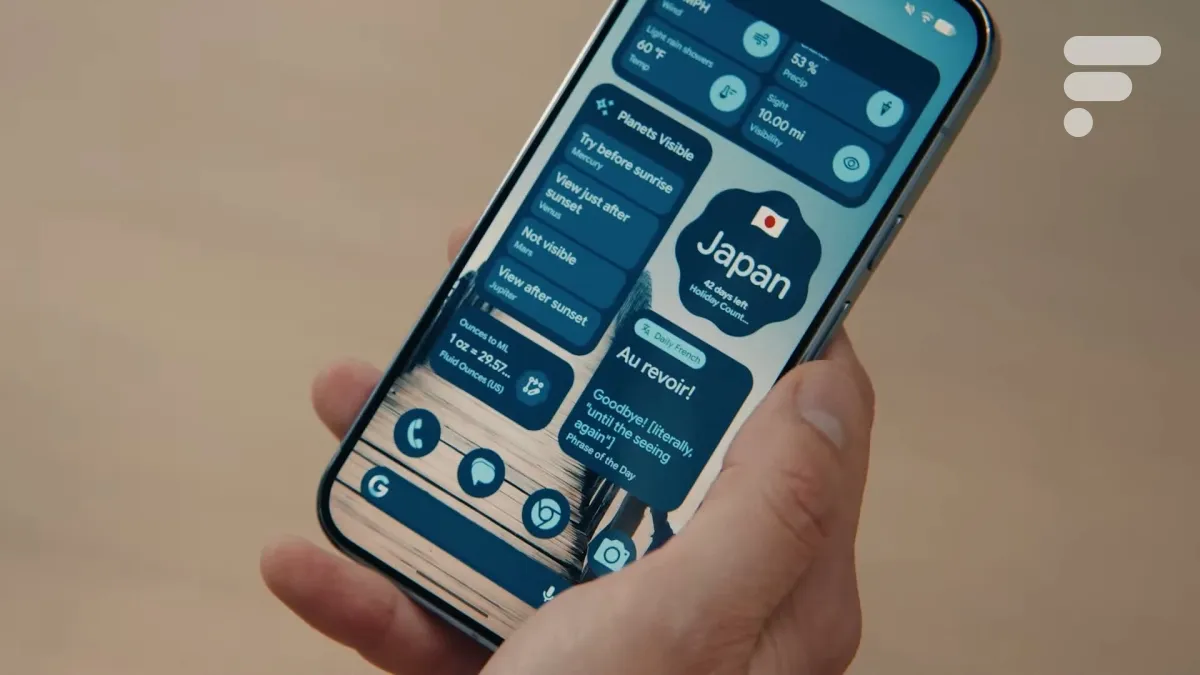
Google unveiled Create My Widget at The Android Show, a Gemini Intelligence tool that generates resizable Android widgets and Wear OS complications from natural language descriptions. It marks the company's first step into generative interfaces created on the fly by AI.
Tap a lens to see what this story means for you.
Liked this? The Brief brings you the whole day in tech, verified, every morning.
Two minutes, free forever. What's in The Brief →
See what’s happening right now
The Feed runs all day — short, verified briefs the moment they break.
Open the FeedFollow @thecircuitry_
Every story we publish, as it happens. No noise between.
Reader-supported
The Circuitry is a passion project I've always wanted to build, and I love the work behind it.
Running it costs real money. APIs, hosting, time. To keep improving the site and growing this into something useful for everyone, those costs have to be covered.
Any contribution is appreciated. If not, no pressure. Thanks for reading.
Google DeepMind, Meta, and Isomorphic Labs are investing $300 million in Biohub to build AI datasets for a virtual cell model. The funding is part of a $1.8 billion initiative that also includes contributions from the Department of Energy and National Institutes of Health.
Anthropic has launched the Anthropic Cyber Mission to support defenders of critical infrastructure and open-source software with models, engineers, and tools. The initiative starts with the Critical Infrastructure Defense Program and free OSS Scanner amid ongoing challenges in verifying and fixing vulnerabilities.
Amazon launched three new Alexa Tablets running full Android with Google Play Store access and prices starting at $229.99. The move targets higher-end buyers with aluminum designs and Alexa+ AI while ending reliance on the limited Fire OS app store.
Anthropic released Claude Haiku 5.5, its cheapest and fastest small model, at $0.10 per million input tokens and $0.50 per million output tokens for prompts up to 100,000 tokens. Anthropic says it costs around 75% less to run than Haiku 4.5 on average and scores far higher on its benchmarks.
OpenAI released 722 mathematical manuscripts, grouped into 372 result families, produced by an unreleased internal model. The papers are on GitHub, with Lean formalizations for many but not all of them, and OpenAI warns some unformalized results could have issues.