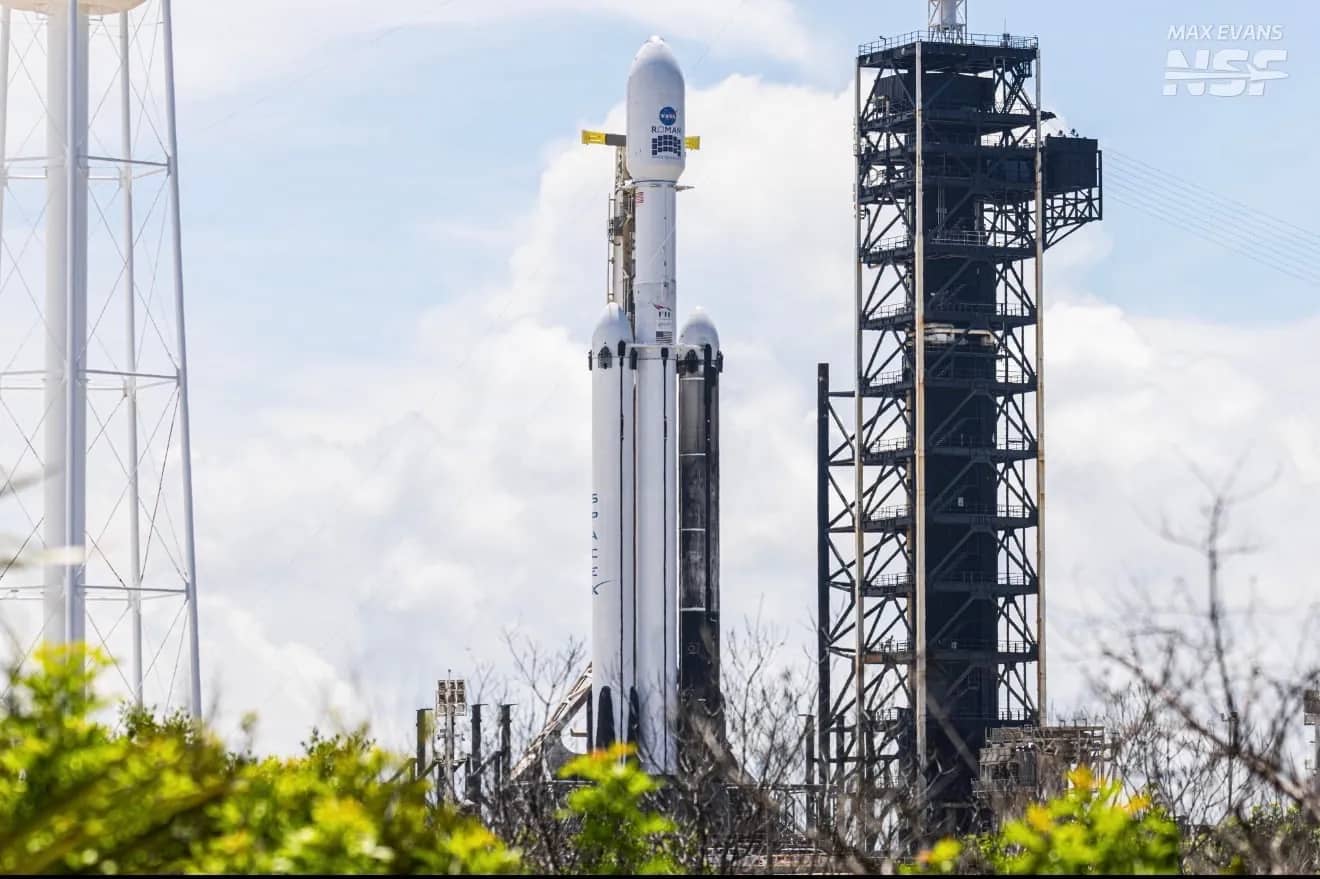
NASA and SpaceX are targeting a 7:26 AM EDT Sunday liftoff of a Falcon Heavy from Kennedy Space Center carrying the Nancy Grace Roman Space Telescope. The observatory will travel to Sun-Earth L2, where its Wide Field and Coronagraph instruments will search for exoplanets and study dark energy.
Corrected Roman Space Telescope cruise to L2 from approximately one month to approximately three months (~100 days), matching NASA.

Although building a telescope from scratch would probably have cost less, adopting the NRO hardware lent the project added political weight.
https://x.com/SpaceX/status/2093791531505184932
Falcon Heavy’s two side boosters are slated to return for landings at separate zones on Cape Canaveral Space Force Station, while the center core will be expended to provide the extra performance required for the heavy payload.
Tap a lens to see what this story means for you.
Liked this? The Brief brings you the whole day in tech, verified, every morning.
Two minutes, free forever. What's in The Brief →
See what’s happening right now
The Feed runs all day — short, verified briefs the moment they break.
Open the FeedFollow @thecircuitry_
Every story we publish, as it happens. No noise between.
Reader-supported
The Circuitry is a passion project I've always wanted to build, and I love the work behind it.
Running it costs real money. APIs, hosting, time. To keep improving the site and growing this into something useful for everyone, those costs have to be covered.
Any contribution is appreciated. If not, no pressure. Thanks for reading.
SpaceX Starship reached orbit for the first time on its 14th test flight from Texas on September 28 despite an early engine shutdown. The vehicle is expected to complete six orbits over 10 hours and deploy 26 Starlink V3 satellites before Pacific splashdown.
NASA awarded SpaceX a $946 million contract for three more crewed missions to the ISS, bringing the company's total under the deal to 17 flights through 2030 and the contract value to $5.92 billion. The expansion helps NASA sustain access to the station while Boeing prepares its Starliner for crewed operations.
SpaceX has delayed the first orbital Starship flight from September 22 to September 28 pending regulatory approval. The mission will attempt to place 26 V3 Starlink satellites into a 275 km orbit and marks a key milestone after the program's initial test flight in 2023.
SpaceX completed a static fire of Booster 20 on July 10, clearing the path for Starship's 13th test flight as early as July 15. The test continues development of the Version 3 vehicle toward full operational capability including stage recovery and reuse.
SpaceX has agreed to acquire Grain Management's nationwide 800 MHz spectrum portfolio, which it says will pave the way for Starlink Mobile to become a major US mobile carrier. The deal needs FCC approval, and financial terms were not disclosed.