The Circuitry
THE CIRCUITRYYour one-stop source for all tech news
HOMETODAYNEWSFEEDEVENTS
BOOKMARKS
RSS
© 2026 The Circuitry
About UsSourcesContactCorrectionsPrivacy
  • Today
  • Feed
  • Events
  • Saved
Scroll for more
Verification
VERIFIEDConfidence: HIGH
Source identified
Claims cross-referenced
No discrepancies found
Sourcing
1source

via NotaTeslaApp

NotaTeslaApp · track record
18Stories
100%Verified
230d
All sources →
Markets
TSLA···

Live quote · not investment advice

From The CircuitryWhy The Circuitry

Verified tech news, cross-checked.

Every story is checked against independent sources before it posts — no rumors dressed up as fact.

How we verify →
Home/Energy/Tesla Relaxes Driver Monitoring With FSD v14.3.3
VERIFIEDBy Xavier Rivera· ·2 min read

Tesla Relaxes Driver Monitoring With FSD v14.3.3

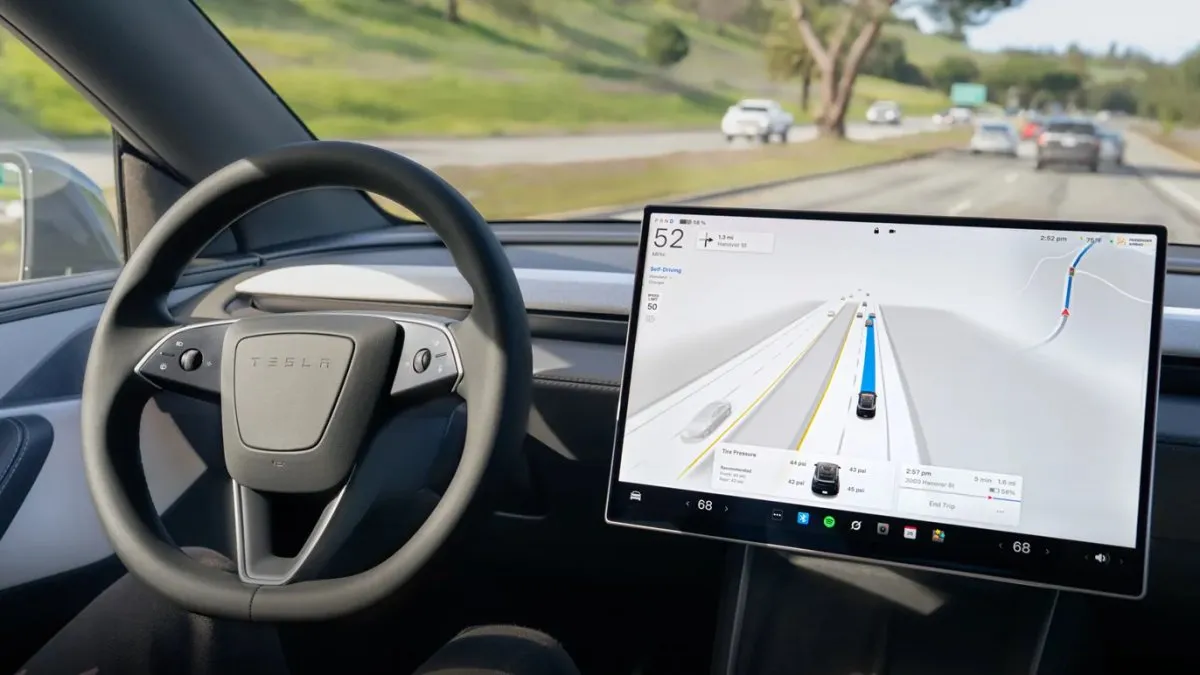
Tesla has relaxed its vision-based driver monitoring requirements in FSD v14.3.3, allowing up to a minute of leeway in some conditions while confirming the change via Elon Musk. The update maintains stricter rules in low-confidence scenarios and Mad Max mode as a step toward unsupervised autonomy.
Source:NotaTeslaApp
Post
Tesla Relaxes Driver Monitoring With FSD v14.3.3
From The CircuitryWhy The Circuitry

Verified tech news, cross-checked.

Every story is checked against independent sources before it posts — no rumors dressed up as fact.

How we verify →
TL;DRAI · 60 sec read

Tesla rolls out FSD v14.3.3 to early testers with relaxed driver monitoring. The update allows drivers to look away for over a minute in some cases before the system prompts attention. Monitoring tightens in low-confidence situations like Mad Max mode. This reduction in oversight reflects Tesla's increased trust in the software's safety and advances progress toward unsupervised autonomy.

Tesla is rolling out its FSD v14.3.3 update to early-access testers this week. The version includes some new features alongside the 2026 Spring Update as well as several quality-of-life improvements and undocumented changes.

Elon Musk confirmed in a post on X that the driver monitor requirements have been eased once again. This continues Tesla's gradual reduction of vision-based attention-monitoring as the company grows more confident in FSD’s margin of safety over human drivers.
The change makes supervised FSD feel like drivers can pay attention to the greater situation rather than micromanaging every small lane change or turn.
Historically, Tesla required drivers to apply slight turning torque to the steering wheel at regular intervals. That system was replaced by cabin camera vision monitoring introduced in FSD v12.
POST FROM @Tesla· official Tesla announcement tweet confirming smoother FSD v14.3.3 with reduced nags
https://x.com/Tesla/status/2056577806981911000
With later versions of v13 and the current widespread v14.2.2, monitoring is already relaxed enough to allow drivers to look around or use their screen for short periods, usually less than 20-30 seconds. Early access testers report that v14.3.3 loosens this further, providing up to a minute of freedom before requiring the driver to look forward and pay attention.
From The CircuitryThe Feed — live briefs across tech, all day.See what’s happening →
Sawyer Merritt posted on X after testing the update: "I just tested this. In some cases, FSD V14.3.3 gives you over a minute before nagging you." The change makes supervised FSD feel like drivers can pay attention to the greater situation rather than micromanaging every small lane change or turn.

The vehicle does not reduce monitoring in every situation. It assesses environmental difficulty and its own confidence level, applying stricter supervision when confidence is lower.

When Mad Max mode is enabled, an on-screen prompt states “Increased attention required, Mad Max profile selected.” This is similar to the prompt that previously appeared in poor weather, with reduced speeds in wet conditions.
From The CircuitryWhy The Circuitry

Verified tech news, cross-checked.

Every story is checked against independent sources before it posts — no rumors dressed up as fact.

How we verify →
By enforcing attention during Mad Max mode or severe weather, FSD proves it is aware of its own operational limits. As the neural network grows more capable of handling complex environments natively, eliminating the need for constant human micromanagement is the exact psychological and regulatory stepping stone Tesla needs to reach an unsupervised, fully autonomous level.
Why this mattersAI · ~100 words

Tap a lens to see what this story means for you.

Morning Brief

Liked this? The Brief brings you the whole day in tech, verified, every morning.

Two minutes, free forever. What's in The Brief →

Reader-supported
DonateBuy me a coffee →Follow@thecircuitry_ →Follow@thecircuitry.to →
HELP US IMPROVE
From The Circuitry

See what’s happening right now

The Feed runs all day — short, verified briefs the moment they break.

Open the Feed →
From The Circuitry

Follow @thecircuitry_

Every story we publish, as it happens. No noise between.

Follow on X ↗On Bluesky ↗

Reader-supported

The Circuitry is a passion project I've always wanted to build, and I love the work behind it.

Running it costs real money. APIs, hosting, time. To keep improving the site and growing this into something useful for everyone, those costs have to be covered.

Any contribution is appreciated. If not, no pressure. Thanks for reading.

Buy me a coffee
TeslaFSDAutonomousDriving
More fromNotaTeslaApp
  • Tesla Opened 1.8M-Sq-Ft Semi Plant for High-Volume Production

    Tech · 14d
  • Tesla Sends Invites for Semi Rollout Event on September 24

    Tech · 27d
  • Tesla Unveils Production Cybercab With Unboxed Manufacturing

    Tech · 1mo
More inEnergy
  • Google Signs Deal with Constellation for Nuclear Power

    Energy · 2d
  • California requires AI data centers to fund local grid and water upgrades

    Energy · 17d
  • US Data Centers Could Use More Natural Gas Than Germany and Japan Combined by 2035, BNEF Says

    Energy · 23d
SupportThe Work

The Circuitry is reader-supported. If you find the daily brief useful, you can buy me a coffee to keep it going.

Buy a coffee →
From The CircuitryWhy The Circuitry

Verified tech news, cross-checked.

Every story is checked against independent sources before it posts — no rumors dressed up as fact.

How we verify →

MORE IN THIS BEAT

All Energy →
  • Tech· 

    Tesla Opened 1.8M-Sq-Ft Semi Plant for High-Volume Production

    Tesla marked the start of high-volume Semi production at its new Sparks, Nevada factory on September 24. The plant, which Tesla says covers 1.8 million square feet, is built to scale to 50,000 trucks annually.

  • Tech· 

    Tesla Audits China Suppliers Ahead of Optimus Production Prep

    Tesla reportedly conducted intensive supplier audits across China's Yangtze River Delta last week as it prepares Optimus production. The visits to potential suppliers Tuopu Group, Sanhua Holding Group, and Joyson Electronics in Ningbo, Hangzhou, and Shanghai leverage existing automotive partners rather than confirming a mass-production acceleration.

  • Tech· 

    Tesla moves next-gen Roadster reveal to October 15

    Tesla postponed its next-gen Roadster reveal from October 1 to October 15, citing severe weather for an outdoor-only event. The company said additional details will follow and did not announce a new start time.

  • Tech· 

    Tesla Sends Invites for Semi Rollout Event on September 24

    Tesla has started sending invitations for its Semi Rollout event on September 24 at the new factory in Sparks, Nevada. The gathering will showcase the facility, which Tesla says covers 1.8 million square feet, built to produce up to 50,000 trucks per year along with refreshed vehicle features and fleet economics.

  • Tech· 

    Electric Mobility Shakeups: Bike Maker Bankruptcy, Tesla FSD Reversal

    A roundup of electric mobility news on September 5, 2026 highlights the August 11 bankruptcy at Accell Group and July 29 judicial recovery for CactUs Lock, a prominent charging myth on French radio, solar battery test results, and a policy reversal on Tesla FSD following July resistance. These stories illustrate ongoing financial fragility, public misunderstanding of EV best practices, and evolving regulatory attitudes across Europe.